
Monday, November 5, 2012

Why Should You Vote? Visualize The Nightmare of Romney World


Why Should You Vote? Visualize The Nightmare of Romney World

My wife, Jan Schakowsky, and I are friends with a wonderful woman named Bea. Bea is now 95 years old. Bea was born in 1917.

She was born in a country where women couldn't vote. In some areas of the country, just fifty years before, slavery had been legal. Collective bargaining was not recognized under the law. Poverty was rampant -- especially among the country's oldest citizens.

Bea was born in a country where there was an unimaginable gulf between a few fabulously wealthy oligarchs, and the masses of ordinary people. It was a country where only a tiny fraction of the population ever went to college -- or even graduated from high school -- a country were hardly anyone was considered "middle class." It was a country where there were few regulations to protect health and safety on the job, no national child labor laws, no federal minimum wage, and very little to prevent corporations from recklessly destroying the environment.

Bea was born in a country where people of color were considered second-class citizens and discrimination against them was enshrined into law -- a country where gays and homosexuals could be prosecuted for their sexual orientation.

Bea was born in the United States of America.

Over her lifetime, Bea has been involved in many of the great social movements of our time -- movements that helped transform our country into the envy of the world.

She was active building the labor unions that build the middle class. won a living wage, weekends and a 40-hour work week, pensions for retirement, and the passage of Social Security and Medicare that ensured a retirement free of poverty.

She marched with the civil rights movement that gave people of color an equal status in American society.

Bea became a public school teacher and helped educate an ever-expanding number of ordinary Americans -- watching more and more of them go on to college to fulfill their dreams.

She was part of the women's movement that demanded equal status and equal pay for women -- as well as the right for women to control their own decisions about contraception and abortion.

This year, Bea -- at 95 years old -- is working on a phone bank to turn out voters for Barack Obama. She says that if Mitt Romney and the Republican Right win the election on Tuesday, they have made clear that they absolutely intend to destroy all of the things for which she has struggled her entire life. She's right.

Mitt Romney has demonstrated over the years that he has only one real core value: his own success.

Throughout his career, Mitt has demonstrated that he will do whatever is necessary to benefit himself -- and his investors. At Bain Capital he didn't flinch when it came to destroying other people's jobs and lives if it would make him and his investors money.

Now his "investors" are the oligarchs of the Republican Right -- people like the Koch brothers and Sheldon Adelson -- who, between them, have spent hundreds of millions of dollars to get him elected. Many are the same people who funded the Tea Party movement. Others are the Wall Street hedge fund barons whose recklessness collapsed the economy and came very close to recreating a Great Depression.

These people -- and their Tea Party allies in Congress -- have shown the country that they have no intention of compromise. They are intent upon rolling back all of the things Bea has fought for -- on sending us back to the Gilded Age. They truly believe that America would be a better place without labor unions. They want to eliminate Medicare and replace it with vouchers of ever-shrinking value that pay private insurance companies.

They want to be free to despoil the environment, do away with public education, eliminate jobs, cut wages, and continue to appropriate every dime of economic growth that is generated by our increasingly productive labor force.

As President Obama said in the second presidential debate, they want send us back to the foreign policy of the 1980's, a social policy of the 1950's and an economic policy of the 1920's. They believe in a society where the law of the jungle reigns supreme -- where you look out for yourself above all else -- where, if you believe you are your brother and sisters' keeper, that we shouldn't leave anyone behind, that we should have each other's back -- you're simply a chump.

If Mitt Romney becomes president, Republicans keep control of the House and win the few seats necessary to control the Senate, there will be nothing to restrain them from making their vision of society a reality in America -- from taking America backward to a time most of us cannot imagine.

What are some of the things a President Romney has promised to do?

    Eliminate Medicare and convert it into a voucher for private insurance -- ending the most popular and successful health care program in American history and raising out of pocket costs for seniors by6,500 a year.

    Privatize and cut Social Security - handing over the Social Security Trust fund to Wall Street and eliminating guaranteed benefits.

    Appoint -- most likely two -- Supreme Court justices who would vote to overturn Roe v. Wade, outlawing abortion rights -- and most likely make the Court a firm ally of unrestrained corporate and Wall Street power for generations.

    Repeal Wall Street Reform. Return us to the pre-crash law that would allow Wall Street to once again run wild, gamble with more and more exotic financial instruments, make a fortune for itself -- and once again wreck the economy.

    Repeal ObamaCare. That by itself would end the promise that no one will ever again be bankrupt by a sudden illness. It will return us to a very recent time when someone who has a pre-existing condition can be denied insurance coverage - and that insurance companies can call the shots when it comes to your health care.

    Pass the Ryan Budget. That would mean slashing critical federal expenditures that benefit the middle class and those who aspire to the middle class, like cutting Medicaid that pays for health care for the poor, children and those in need of nursing homes or home care -- and slashing funds for education and college grants.

    Increase military spending by two trillion dollars above the amount requested by the military leadership. That might benefit big defense contractors, but it would make it practically impossible to reduce the giant federal deficit.

    Give the wealthy an additional 5 trillion dollar tax cut and pay for it by increasing the effective tax rate paid by the middle class.
    Stop funding for Planned Parenthood and any other family planning programs that we fund around the world that use their own funds to pay for abortions.

    Try to pass the "Personhood" Amendment that would effectively outlaw all abortions and many forms of hormonal contraception.

    Allow many of the same Neo-Con foreign policy advisers who got us into the Iraq War to once again take control of American foreign policy.

    Veto the Dream Act that would allow young people who were brought to America as children to apply for citizenship.

    Eliminate the Presidential Directive that prevents the deportation of Dream Act-eligible young people.

    Empower people like Kris Kobach, the Kansas Secretary of State who wrote the Arizona "papers please" law and now serves as Romney's chief adviser on immigration.

    Slash environmental regulations and investment in clean energy development.

The list goes on and on.

But worse than the individual initiatives that Romney and Ryan have made clear they would undertake, is the attitude they would bring to decision-making.

Romney's true views were laid bare in the now famous "47 percent video" where he explained how he could not convince 47% of Americans to take responsibility for their lives -- people like retirees who worked all of their lives for their Social Security and Medicare -- people like veterans who risked their lives for the country -- people like the disabled -- in fact, pretty much anyone who doesn't agree with his "we're all in this alone" view of American society.

If Mitt Romney and Paul Ryan are elected on Tuesday, they will turn back the clock on progress in America. If they are allowed to do so by a Republican House and Senate, they would return us to a time we could scarcely imagine.

For those who believe in a society where we're all in this together, Tuesday's election is the mother of all battles.

Every conservative Republican president since Nixon has moved further and further to the extreme Right. Many thought George W. Bush would be the last radical right-wing president. Most Americans saw that radical conservatives had lied us into a $3 trillion dollar war and their accumulated economic policies were the cause of the worse economic crash since 1929 - Americans lost between $14 and $17 trillion dollars of their wealth. yet somehow here we are again with a clueless plutocrat that wants to mold the USA into 17th century France, with the overlords at the top and everyone else working hard just to get survive.

Obama Gains Edge in Campaign's Final Days - still every vote is needed.

Romney staff refusing to let frostbitten children leave PA rally

Saturday, November 3, 2012

Conservatives Who Think That Women Should Have Fewer Rights Than Men May Cost Republicans Victory, But Save America From A Radical Agenda


Conservatives Who Think That Women Should Have Fewer Rights Than Men May Cost Republicans Victory, But Save America From A Radical Agenda

What if misogyny ends up costing Republicans the Senate? Judging by the polls in the final days before the election, this is not a crazy proposition — especially if “gaffes” on abortion, rape and contraception are equated by the electorate with extremism, repelling even ideologically sympathetic voters.

Just look at Indiana, a state that is choosing between two “pro-life” candidates, one of whom is a Democrat who has voted for House Republicans’ most restrictive legislation on reproductive rights. Still, Joe Donnelly managed to avoid doing what Richard Mourdock did – getting famous for talking insensitively about rape. They’ve been tied or within inches of each other for weeks, but as of today, the first post-rape-comment poll, Mourdock is down 11 points. Meanwhile, Mourdock’s rape-talking fellow traveler in Missouri, Senate candidate Todd Akin, is locked in a race that was never supposed to be competitive, and a cash infusion may come too late to save him. And in Connecticut and Massachusetts, both abortion and contraception have been used to pummel relatively moderate Republicans with the ever-rightward agenda of the national party, and for that reason and more, it’s looking like Democrats will prevail.

This is about more than the so-called gender gap, though women do tend to vote disproportionately to our share in the population and historically favor Democrats. And it’s about more than “pro-life” and “pro-choice,” where, at least as far as those fuzzy words go, the former has a slight edge in polling. When abortion conversations turn to rape, exceptions for which are broadly, if inconsistently, supported by voters, they also suddenly become about a broader callousness and indifference to suffering, one that jibes with messaging about slashing Medicare and Medicaid. Voters drifting away from Mourdock would probably never use the word “misogyny,” but as I’ve said, as the Republican agenda on sex and reproduction gets explained in full, we’re hearing very little about compassion for fetal life and a lot about women having sex.

Pro-choice activists have been saying this for years, but didn’t get much credence until elected Republicans gave a larger platform for marginal and largely discredited views — rape victims can’t get pregnant (Akin); exceptions to save a woman’s life are never needed (Rep. Joe Walsh); consensual sex, and getting pregnant from it, is as shameful as rape (GOP Senate candidate Tom Smith, who hasn’t been able to close the deal in Pennsylvania). The same goes for defunding Planned Parenthood and repealing Obamacare, or at the very least getting rid of the birth control coverage in it — these days, virtually uncontested across Republicans in office or running for it. That may work well in a House race, but it’s proving a tougher sell statewide — and, judging by Romney’s ads soft-pedaling his stances on abortion and contraception, nationally as well.

If you want to know where this all came from or where it’s going, check out Emily Bazelon’s profile of the Americans United for Life president in the New York  Times magazine. AUL has been as influential as any group in crafting the state-level abortion restrictions and rhetoric around them, taking the murky anti-choice rhetoric and mainstreaming it in a palatable and reasonable-sounding way. Yoest “believes that embryos have legal rights and opposes birth control, like the IUD, that she thinks ‘has life-ending properties.’” (She can think that, but it doesn’t make it medically accurate.) She refuses to discuss a study showing that the abortion rate drops dramatically when you make long-acting reversible birth control — like the IUD — free to women who want it, mimicking Obamacare’s full coverage under insurance. And yet she knows that when you talk about birth control and abortion as connected to women’s reproductive and sexual autonomy, the anti-choice side loses. She said as much on PBS, Bazelon notes: ““It’s really a red herring that the abortion lobby likes to bring up by conflating abortion and birth control … Because that would be, frankly, carrying water for the other side to allow them to redefine the issue in that way.”

Instead of outright repealing the 19th Amendment( guaranteeing women the right to vote) and other progressive legislation that have leveled the playing field over the years in one fail swoop, Republicans have been pretty successful in chipping away at the rights of women to be full citizens. And Mittens is no friend to more than have the country. He thinks conservatives and big government should control women,Top 6 Lies Romney Has Told Women in an Election Season Full of Whoppers, Mitt has assembled a binder full of bs on issues that matter to more than half the population

Republicans are resorting to some weird extortion to get the vote, The GOP Will Destroy America If We Reelect Obama, So We Must Let the GOP Win


Thursday, November 1, 2012

Why Vote For President Obama and Democrats in General


GOP U.S. Senate candidate Richard Mourdock and Romney's friend believes pregnancies from rape are a gift from God. Where is he from? Iran?


Why Vote For President Obama and Democrats in General

Waiting in line for two-and-a-half hours is rarely an exciting experience. But when my son and I voted early—he for the first time—at a community center in Rockville, Md., both of us were inspired by the hundreds of other people intent on exercising democracy’s most basic right.

In our deep blue county, this was largely an Obama crowd, crossing the boundaries of race, class and age. It was white, African American and Latino, young, middle-aged and old. These citizens eager to lift their voices reminded us that in this campaign, one coalition includes almost every kind of American. If Obama wins, he will owe his re-election to a little bit of all of us: blue-collar white voters in the Midwest, upscale voters in the Northeast and on the West Coast, an overwhelming percentage of Latino voters turned off by a new nativism on the right, and near unanimous solidarity on his behalf among African Americans. Obama is not the sort to think about dismissing 47% of us.
The sweep of the Obama coalition represented in that snaking line led my son and me to conclude something else: The President Obama of 2012 may no longer stir the jubilation called forth by the Barack Obama of 2008. But the hope and resolve he spoke of then have not vanished.

Yes, those feelings have been tempered by hard times and four years of bitter political struggle. Obama appears now less as a savior than as a human being with flaws and virtues, failures and successes. The hope of four years ago has transformed itself into something more mature and durable: a confidence in what an increasingly diverse, tolerant and open America can achieve. It is a view that flatly rejects the fears of those who see our country in decline and who always insist that the good old days should be our standard for the future. A nation that has produced Greatest Generations in the past can do so again. Indeed, I think we’re doing so right now.

In making electoral decisions, voters sensibly combine hard judgments about where candidates stand with instinctive calculations about how character might influence their choices in situations we cannot imagine today.

Ronald Reagan offered the most widely honored question about the practical matters: Are you better off than you were four years ago? And for most of the country, the answer is yes. Obama inherited an economy in shambles—the GDP was shrinking at an annual rate of nearly 9% when he took office—and turned it around. Unemployment is well down from its peak, 4.5 million private-sector jobs have been created since January 2010, the stock market has doubled since it hit bottom, and the housing market is stabilizing. Mitt Romney can promise 12 million more jobs in the coming four years because Obama’s policies have already put us on track to produce them, courtesy of a revival of manufacturing, a rise in exports and a new wave of research and innovation.


Most relevant to this year’s choice is the fact that the economy is in far better shape than it would have been if we had followed the counsel of Obama’s foes. They would have allowed the auto industry to collapse. They would have ignored history’s lesson that government must step in to stimulate economic activity when private demand plummets. We know from the experience of Europe that austerity leads to stagnation. Obama made the better choice.

Romney has at times condemned Obama’s stimulus plan while standing in front of enterprises returned to prosperity by the stimulus. Paul Ryan denounced the stimulus and then sought its succor for companies in his district. Watch what they do, not what they say.

Obama has revived a practical, sober and realistic foreign policy in the tradition of George H.W. Bush. Democrats crow about the killing of Osama bin Laden and thrill to Vice President Joe Biden’s handy bumper-sticker line “Osama bin Laden is dead, and GM is alive.” But behind the quip is a reality: Obama has transformed the war on terrorism from an all-purpose slogan designed to rationalize all manner of foreign policy adventures to a focused effort to keep the country safe. By ending the war in Iraq, winding down our commitment in Afghanistan and abandoning grandiose adventurism, he has redirected U.S. foreign policy toward the classic and sensible goals of preserving our power and influence and shaping an international environment congenial to our prosperity and our values.

Republicans bridle at the idea that Obama has restored respect for our country around the world. But it’s true. An Obama defeat would threaten many of his diplomatic achievements, including building what one pro-Western ambassador called “a successful coalition of the unlike-minded and unwilling” to confront Iran.

The strongest endorsement of Obama’s choices came from his opponent. In the third debate, Romney abandoned months of bellicose rhetoric and lined up behind one Obama decision after another. In this polarized political era, poll-tested imitation is about the only form of flattery we can expect. When Romney declared that “we don’t want another Iraq,” he was blessing the transition from George W. Bush’s era to Obama’s.

Obama’s decision to ignore cautious political advisers and see through the health care reform fight came at great political cost. Even some of his allies think the electoral price was too high. But this is a measure of Obama’s fortitude. By bringing the promise of health insurance to tens of millions of our citizens, Obama ended a national scandal. No other wealthy nation allows so many to live without basic coverage for illness or to rely on emergency rooms as a last resort. They either arrive there long after the opportunity to get well has passed, or they survive only to face years, sometimes a lifetime, of debt. The Affordable Care Act is an achievement worthy of our great reforming Presidents.

Once again Romney’s behavior proves the point. He speaks of repealing Obamacare only in general terms. When it comes to so many of the specifics—on prohibiting insurance discrimination against those with pre-existing conditions, for example, or on making it easier for parents to cover their adult children—Romney winds up backing what Obama did.

Beyond these large questions are concrete Obama achievements: his support for women’s rights, including the Lilly Ledbetter Fair Pay Act; the end of “Don’t ask, don’t tell” and his endorsement of gay marriage; passage of Wall Street reform, including the creation of the Consumer Financial Protection Bureau; reform of the student-loan program; his appointments of Elena Kagan and Sonia Sotomayor to the Supreme Court, checking the right-wing drift in the judiciary that gave us decisions like Citizens United; and many of the investments in the stimulus package, notably in clean energy. In quieter times, these would be playing a much larger role in the campaign.

All are part of the case for Obama. But the best reason for his re-election goes back to what motivated so many middle-of-the-road voters four years ago. Americans who want to replace polarization with balance, extremism with moderation, obstruction with problem solving and blind partisanship with compromise need Obama to win again. An Obama defeat would empower those whose go-for-broke approach to politics is largely responsible for the distemper of our public life and the dysfunction in Washington.

This election does not represent a choice between left and right. It represents a choice between balance and a new, extreme form of conservatism. This new conservatism cannot accept any tax increases as part of a deal to reduce the deficit. For all his attempts to sound moderate in the campaign’s closing days, Romney has not altered the response he gave during a Republican-primary debate rejecting a hypothetical deal involving a 10-to-1 ratio between spending cuts and tax increases. This refusal to acknowledge the need for more revenue is a recipe for eviscerating government—and the cuts, as Ryan’s budget shows, would fall disproportionately on programs for Americans with the lowest incomes.

The new right has broken with conservatism’s past—and our country’s most constructive traditions—by adopting a new and radical individualism that largely ignores our country’s gift for community.

The America of Alexander Hamilton, Henry Clay, Abraham Lincoln and both the Republican and Democratic Roosevelts understood that government has a role to play in tempering the market and making investments the market depends on but will not make itself. The new conservatism measures freedom almost entirely in terms of the share of the nation’s GDP that flows to the state, as if spending on Medicare, Social Security, student loans, community colleges and infrastructure improvements somehow made us less “free.” And in the face of growing economic inequality, the new conservatism regularly discounts or condemns government’s role in leaning toward modestly greater equity, promoting upward mobility and checking concentrated economic power. It is this variety of conservatism that Romney bowed to in the primaries and would be forced to accommodate if he became President, whatever his constantly shifting views might actually be.


Obama, to a fault, devoted enormous energy during his first 21/2 years in office trying to move his opponents to compromise. Thus was almost a third of his stimulus plan devoted to tax cuts. Thus did he model his health care plan after Romney’s in Massachusetts. Thus did he seek a deal with House Speaker John Boehner during the debt-ceiling confrontation that, if enacted, would have disappointed many of the President’s progressive supporters. Only those who confuse compromise with capitulation can claim that Obama did not try mightily to keep his promise to end partisanship in Washington.

Obama should win a referendum on his stewardship. But this is also a choice—a “big choice,” just as Romney says—between moderation and a return to an approach to government more suited to the Gilded Age than to the 21st century. Obama is battling to defend the long consensus that has guided American government successfully since the Progressive Era. It is based on the view that ours is a country whose Constitution begins with the word we, not me, and that the private success we honor depends on a government that serves a common good and remembers the most vulnerable among us. The task of our moment is to revive that long consensus and renew it. Of the two major candidates, only Barack Obama accepts this mission as his own.


....................................................................................................

Richard Mourdock On Abortion: Pregnancy From Rape Is 'Something God Intended'

Indiana GOP U.S. Senate candidate Richard Mourdock declared Tuesday night he opposes aborting pregnancies conceived in rape because "it is something that God intended to happen."

Debating Rep. Joe Donnelly (D-Ind.) in their final Senate race showdown, a questioner asked them and Libertarian candidate Andrew Horning to explain their views on abortion.

All three said they were anti-abortion. But Mourdock went further, putting himself in territory near Missouri GOP Senate candidate Rep. Todd Akin, the anti-abortion congressman who infamously asserted that women don't get pregnant from "legitimate rape."

"The only exception I have to have an abortion is in the case of the life of the mother," said Mourdock, the Tea Party-backed state treasurer. "I struggled with it myself for a long time, but I came to realize life is that gift from God. I think that even when life begins in that horrible situation of rape, that it is something that God intended to happen."
Mourdock should offend every Christian, every descent human being in the USA for having the arrogance and morally bankrupt idea that God thinks rapes and their consequences are good deeds. How do utter wackos like Mourdock get even 2% of the vote.

Tuesday, October 30, 2012

Rep. Marsha Blackburn (R-TN) is a world class moron unfit to be in Congress - Accuses Obama Of ‘Harming’ Auto Company That Went Defunct In 1988

Rep. Marsha Blackburn (R-TN) is a world class moron unfit to be in Congress - Accuses Obama Of ‘Harming’ Auto Company That Went Defunct In 1988

A Republican congresswoman accused the Obama administration of promulgating regulations that are undermining job creation at an auto manufacturer that has been defunct since 1988. She was responding to a question on Monday about Mitt Romney’s dishonest claims regarding Jeep moving its production overseas.

During an appearance on MSNBC, Rep. Marsha Blackburn (R-TN) dodged a question about Romney’s debunked Jeep claims and instead attacked the Obama administration for issuing regulations that are harming workers at American Motors Corporation, a company once headed by George Romney. AMC was sold to Chrysler during the Ronald Reagan administration and its brands were then discontinued..

Conservatives consider complete and utter incompetence a bonus rather than a disqualifying feature for public office.

Conservative Republican Strategist Defends Romney’s Plan To Dismantle FEMA


Conservative Republican Strategist Defends Mitt Romney’s Plan To Dismantle FEMA

Mitt Romney’s past comments about dismantling FEMA and privatizing disaster relief have come back to haunt him as Hurricane Sandy begins to wreak havoc on the East Coast. Still, one Republican strategist, Ron Bonjean, agrees with him. On CNN Monday morning, Bonjean, a private consultant who advises GOP congressional leaders, defended Romney, suggesting that even talking about federal disaster relief is politically toxic:

    Most people don’t have a positive impression of FEMA and I think Mitt Romney was right on the button. But I don’t think anybody cares about that right now. I think people care about whether or not their power’s on, whether or not their basement’s going to be flooded. And I think that if the president gets too far in front of this and something goes wrong, people are going to remember, hey, my power’s not out, and the president’s talking about FEMA. I’m not a real big fan of FEMA. That could sway their vote.


Sandy has already caused severe flooding in the Northeast, hours before the worst of the storm is projected to hit. President Obama has declared a state of emergency in 7 states and DC after several governors’ urgent requests for federal aid to combat the storm. Though Bonjean fails to make the connection between FEMA’s services and people worrying about their power going out, the agency has already dispatched emergency power teams to try to reinforce vulnerable power grids before the storm hits and provided hundreds of generators and other back-up power sources. Americans are unfortunately well-acquainted with the agency, despite Bonjean’s insistence that they “don’t care” about it; a recent study of FEMA data found that, since 2006, 4 out of 5 Americans have been affected by weather-related disasters.

No one wants government that is too big, that is just common sense. Conservative Republicans have take that to the wacko extreme, they just plain do not want government to work. Like Exxon, BP, chemical, mining and insurance companies always do the right thing and are never unethical or inefficient. To be a conservative takes tremendous powers of denial about reality.

Morally Corrupt Romney campaign falsely training Wisc. poll watchers that IDs ‘must include photo’

Never let a tragedy go unexploited: Sleazebag Romney playing campaign videos at ‘storm relief events’

Sunday, October 28, 2012

What is a Nightmare? The Day After Morally Bankrupt Mitt Romney is Elected


What is a Nightmare? The Day After Morally Bankrupt Mitt Romney is Elected

Despite the difficulty nailing down a chameleon-like candidate's positions, we've tried to discern some of the economic measures that Romney would likely champion if he wins. We'll follow up with a look at non-economic policies in the coming days.

1. The Romney-Ryan Budget

Let's assume, for the moment, that the Republicans take the Senate.

Mitt Romney has at times embraced Paul Ryan's “roadmap [3],” and he's also distanced himself from it. But there will be quite a bit of pressure from conservative activists and the Republican House to enact something along the lines of the roadmap.

There are two things to understand about Paul Ryan's budget. First, it has been carefully written so that most of its provisions can be passed under a process known as budget reconciliation, which requires only a simple majority of votes in the Senate. Second, it is a right-wing fantasy that, if enacted as written, would trigger a major drop in employment and send the economy into a tailspin. Its cuts are so deep, and would effect so many constituents – including traditionally Republican constituents – that it would have to be modified. It's one thing to campaign on such a plan and another to govern with it.

What does it do? According to the Center for Budget and Policy Priorities [4], “by 2050, most of the federal government aside from Social Security, healthcare and defense would cease to exist, according to figures in a Congressional Budget Office analysis.”

    The CBO report, prepared at Chairman Ryan’s request, shows that Ryan’s budget path would shrink federal expenditures for everything other than Social Security, Medicare, Medicaid, the Children’s Health Insurance Program (CHIP), and interest payments to just 3¾ percent of the gross domestic product (GDP) by 2050. Since, as CBO notes, “spending for defense alone has not been lower than 3 percent of GDP in any year [since World War II]” and Ryan seeks a high level of defense spending — he increases defense funding by $228 billion over the next ten years above the pre-sequestration baseline — the rest of government would largely have to disappear. That includes everything from veterans’ programs to medical and scientific research, highways, education, nearly all programs for low-income families and individuals other than Medicaid, national parks, border patrols, protection of food safety and the water supply, law enforcement, and the like.

Ryan has already modified his plan in response to the outcry over a CBO analysis that found future retirees would face $6,400 more in out-of-pocket healthcare costs. We can expect further modifications because no Republican administration is actually going to slash veterans' benefits to the bone, to name just one example. It's untenable, but that doesn't mean President Romney wouldn't push through something moderately less damaging.

2. Tax Cuts or rewarding rich people for being rich, not for work.

Romney promises to slash taxes by 20 percent across the board, maintain deductions enjoyed by the middle class and not decrease the share of taxes paid by the wealthy (or anyone else). We know Romney's math simply doesn't work [5] – it's impossible. http://www.cbpp.org/cms/index.cfm?fa=view&id=3708

But while the whole doesn't add up, Romney could get a number of those provisions passed, like eliminating the inheritance tax, the Alternative Minimum Tax (which hits high earners), and certainly keeping the “Bush tax cuts” on income investment in place.

When a candidate presents a plan that literally does not add up, it's not possible to predict what he'd do with any specificity once in office. Based on the recent history of GOP governance, the sharp right turn the party's taken in recent years and Mitt Romney's own background, one can be reasonably confident that Romney would cut taxes on high earners and corporations, but projecting by how much – and whether it would be financed through deficits, additional cuts or higher taxes on the middle class – is an exercise in reading the tea leaves.

3. ObamaCare

Mitt Romney has pledged to repeal ObamaCare and replace it with a plan that, while light on details, would be centered around health savings accounts and insurance deregulation. Employers would throw some cash into the accounts, people would get some tax breaks and then the miracle of the free market will supposedly swoop in and fix our broken healthcare system.

Repealing ObamaCare may not be as cut-and-dried as the Republican base has been led to believe, however. Contrary to the mythology surrounding the program, the Congressional Budget Office projects ObamaCare to reduce the deficit by hundreds of billions of dollars in the coming decade and beyond. According to Senate rules now in effect, the reconciliation process cannot be used to pass anything that increases the budget deficit 10 years from now.

There are ways to get around procedural rules, and failing that, the executive branch has a lot of discretion in terms of implementation. A Romney adviser told Politico [6] that if the Dems hold the Senate, “we would just have to try to grind out changes by starving ObamaCare through regulations.”

If Romney is able to repeal ObamaCare and replace it with his plan, a study by the Commonwealth Fund [7] projects that it will leave 72 million uninsured by 2022 – 45 million more than is projected under ObamaCare.
A tragic irony is that Romney's healthcare plan would likely prove to be a fatal blow [8] to the best thing he's ever accomplished in public service – the “RomneyCare” scheme in Massachussetts.

4. Medicare

There is little doubt that Mitt Romney would pursue a variant of Paul Ryan's plan to voucherize Medicare for those who retire after a given date (in Ryan's plan it's 2023). Seniors would at first get a voucher sufficient to cover the cost of a private insurance plan comparable to Medicare. But the value of that voucher would only increase by the rate of overall economic growth plus 0.5 percent. The problem is that healthcare costs grow a lot faster. The difference would be borne by seniors themselves – it does nothing to contain healthcare costs, it just shifts them from the government to the backs of individuals.

When the CBO scored Ryan's first plan in 2011, it found that seniors would face an additional $6,400 in out-of-pocket expenses by 2022. After Democrats jumped on that figure, Ryan released a new plan, which called for Congress to come up with some unspecified remedy. CBO wasn't able to score it, but said [9] “beneficiaries might face higher costs.”

Ryan would also raise the retirement age to 67, a measure Romney has endorsed.

It's entirely possible that a President Romney would sweeten the deal a bit to make those numbers look better in the medium-term, but any voucher plan that doesn't keep up with the actual increase in healthcare costs achieves the same thing -- eventually shifting part of the burden onto seniors.

5. Medicaid

While Medicare has received the most attention, Ryan's plan for Medicaid, which Mitt Romney has endorsed, would be a more devastating hit to our threadbare social safety net.

Ryan's plan would turn Medicaid into a block-grant program, cap its funding – cutting $800 billion from the program over the next decade -- and then send it to the states to administer. The first problem is that states – presumably red states – would be free to make it harder to qualify, and the second is that the program wouldn't have the funding flexibility to enroll more people during economic downturns.

Medicaid serves 60 million Americans, about 10 million more than Medicare. Most people think Medicaid only serves the poor, but Medicaid is indespensible for the disabled, especially the severely diabled who require a lot of care. It also covers Medicare's out-of-pocket expenses for retirees with limited incomes.

6. Social Security

George W. Bush learned the hard way that privatizing Social Security is a great way to make voters hate you. That's why the Ryan plan is quite vague. It calls for "action on Social Security by requiring both the President and the Congress to put forward specific ideas and legislation to ensure the sustainable solvency of this critical program." The budget does tout "reforms that take into account increases in longevity, to arrest the demographic problems that are undermining Social Security's finances” – which sounds a lot like raising the retirement age.

7. State Children's Health Insurance Program (S-CHIP)

S-CHIP is likely to be hit hard under a Romney administration if he has a Republican Congress. Under the Ryan plan, S-CHIP could only increase by the rate of inflation, which again, is much slower than the projected rate of healthcare cost inflation. The CBO looked at Medicaid and S-CHIP together, and found that spending on the two programs would be about 70 percent less than currently projected by the year 2050 under Ryan's "roadmap."

8. The Rest

If the Republicans run the field in a big win, expect a lot of talk about a constitutional amendment capping federal spending at a given share of our gross domestic product. It will only be talk. It's a right-wing fantasy of a policy that can only be enacted with a constitutional amendment, which isn't going to happen.

That doesn't mean there won't be deep, deep cuts to non-defense discretionary spending under a Romney administration. Under the Ryan plan, non-defense discretionary spending would be on a downward trajectory leading to 39 percent less funding than currently projected by the year 2040. What is “non-defense discretionary spending”? Well, about 40 percent is education, training and research, and the rest is veterans' programs, various programs for low-income families, public safety and disaster response and the like. It's basically government, absent the Pentagon budget, Social Security and Medicare.

9. If Dems Have 40-50 Seats in Senate (With Ryan the Tie-Breaking Vote)

Although he has been vocal in his opposition in the past [10], there's a good chance that as Senate Majority Leader, Mitch McConnell, R-Kentucky, might embrace filibuster reform – dropping the number of votes needed to overcome a filibuster from 60 -- if the Dems hold a minority in the upper chamber.

Either way, one thing not to expect in this scenario is Senate Democrats turning the tables on the GOP and blocking their legislative agenda at every turn. That's a strategy the Republicans can undertake because their overarching narrative is that governent doesn't do anything right – it ultimately works to their benefit when they can “prove” that theory by rendering Congress incapable of action. Democrats still adhere to the idea that good governance can improve our society, so they can't play the same game and get away with it.

10. If Dems Hold Senate

If the Dems hold the Senate they will act as a firewall against the radical restructuring of the public sector promised by the Ryan budget.

That means maintaining the status quo, more or less, at least through 2014, with one painful exception. Cheered on by the Beltway media, the Democrats, having embraced the non-existent recommendations of the Simpson-Bowles commission (the chairmen drafted recommendations but the gang of 18 didn't vote to approve them), would almost certainly be willing to strike a “grand bargain” with President Romney along those lines.

The only question is whether Speaker Boehner (or Cantor?) would have any trouble coming up with the votes for a “balanced” deficit reduction deal – for a deal that raises some new revenues. If history is any guide, even the most ideological House Republicans will support a Republican president in such an effort.

Currently, non-defense discretionary spending is expected to hit its lowest level since 1962, and Simpson-Bowles would cut deeper still – with a 3:1 ratio of spending cuts to tax increases. That means programs that help the poor and middle class will be on the chopping block. Simpson-Bowles also called for a hike in the Social Security retirement age, despite the fact that life expectancies have only increased significantly for the well-to-do who don't rely on the program as heavily as working people and the poor.

The U.S. is still the richest nation in the world ( maybe 2nd, some economists think China passed us) yet Romney-Ryan would have half the population living in their own 3rd world like conditions. Conservatives talk about imgiinary death panels - the reality is that a conservative president and a conservative Congress will literary mean the deaths of millions of senior citizens and disabled. besides their wacky UnAmerican ideology, why are conservatives going to try and pass this kind of cruel legislation/ Because they do not want to rise taxes on billionaires who are complaining they're not making enough money. Seriously. These same billionaires and multimillionaires are also threatening to fire employees if they do not vote for immoral Mitt.

Paul Ryan Takes a Side in the War on Poverty: He's Against What Works

Condi Rice Pours Cold Water On ‘Benghazi-Gate’

The Republican propaganda channel and Anti-American Fox New's John Roberts Whitewashes Romney's Position On Auto Rescue

Friday, October 26, 2012

What Would a Mitt Romney Economy Look Like, Stealing From The Working Class To Give More to The Wealthy

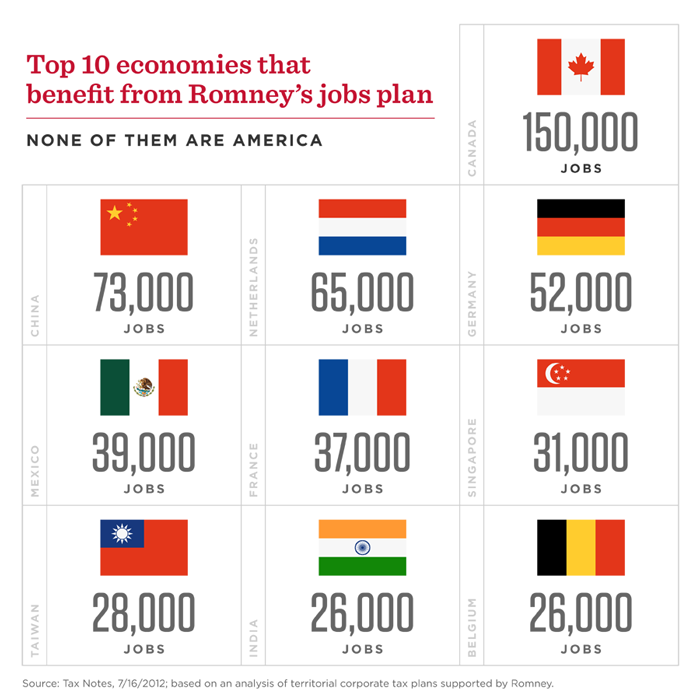
Does Mitt Romney hate The USA. He has created more jobs in other countries than he has in America


What Would a Mitt Romney Economy Look Like, Stealing From The Working Class To Give More to The Wealthy

Mitt Romney’s best argument on the campaign trail has been simple: Under President Obama, the American economy has remained excruciatingly weak, far underperforming the White House’s own projections.

That’s a fair criticism.

But Obama’s best response could be this: If you want to see how Romney’s economic policies would work out, take a look at Europe. And weep.

In the last few years, Germany and Britain, in particular, have implemented precisely the policies that Romney favors, and they have been richly praised by Republicans here as a result. Yet these days those economies seem, to use a German technical term, kaput.

Is Europe a fair comparison? Well, Republicans seem to think so, because they came up with it. In the last few years, they’ve repeatedly cited Republican-style austerity in places like Germany and Britain as a model for America.

Let’s dial back the time machine and listen up:

“Europe is already setting an example for the U.S.,” Representative Kenny Marchant, a Texas Republican, said in 2010. (You know things are bad when a Texas Republican is calling for Americans to study at the feet of those socialist Europeans.)

The same year, Karl Rove praised European austerity as a model for America and approvingly quoted the leader of the European Central Bank as saying: “The idea that austerity measures could trigger stagnation is incorrect.”

Representative Steve King of Iowa, another Republican, praised Chancellor Angela Merkel of Germany for preaching austerity and said: “It ought to hit home to our president of the United States. It ought to hit all of us here in this country.”

“The president should learn a lesson from the ‘German Miracle,’ ” Representative Joe Wilson of South Carolina, a Republican, urged on the House floor in July 2011.

Also in 2011, Senator Jeff Sessions of Alabama, the top Republican on the Senate Budget Committee, denounced Obama’s economic management and said: “We need a budget with a bold vision — like those unveiled in Britain and New Jersey.”

O.K. Let’s see how that’s working out.

New Jersey isn’t overseas, but since Sessions and many other Republicans have hailed it as a shining model of austerity, let’s start there. New Jersey ranked 47th in economic growth last year. When Gov. Chris Christie took office in 2010 and began to impose austerity measures, New Jersey ranked 35th in its unemployment rate; now it ranks 48th.

Senator Sessions, do we really aspire for the same in America as a whole?

Something similar has happened internationally. The International Monetary Fund this month downgraded its estimates for global economic growth, with only one major bright spot in the West. That would be the United States, expected to grow a bit more than 2 percent this year and next.

In contrast, Europe’s economy is expected to shrink this year and have negligible growth next year. The I.M.F. projects that Germany will grow less than 1 percent this year and next, while Britain’s economy is contracting this year.

Karl Rove, that sounds a lot like stagnation to me.

All this is exactly what economic textbooks predicted. Since Keynes, it’s been understood that, in a downturn, governments should go into deficit to stimulate demand; that’s how we got out of the Great Depression. And recent European data and I.M.F. analyses underscore that austerity in the middle of a downturn not only doesn’t help but leads to even higher ratios of debt to economic output.

So, yes, Republicans have a legitimate point about the long-term need to curb deficits and entitlement growth. But, no, it isn’t reasonable for Republicans to advocate austerity in the middle of a downturn. On that, they’re empirically wrong.

If there were still doubt about this, we’ve had a lovely natural experiment in the last few years, as the Republicans in previous years were happy to point out. All industrialized countries experienced similar slowdowns, and the United States under Obama chose a massive stimulus while Germany and Britain chose Republican-endorsed austerity.

Neither approach worked brilliantly. Obama’s initial economic stimulus created at least 1.4 million jobs, according to the nonpartisan Congressional Budget Office. But that wasn’t enough, and it was partly negated by austerity in state and local governments.

Still, America’s economy is now the fastest growing among major countries in the West, and Britain’s is shrinking. Which would you prefer?

I’m not suggesting Obama distribute bumper stickers saying: “It Could Be Worse.” He might want to stick with: “Osama’s Dead and G.M. Is Alive.”

Yes, there are differences between Europe and America. But Republicans were right to call attention to this empirical experiment.

The results are in. And, as Representative King suggested, the lessons “ought to hit all of us here in this country.”

If a modern radical political movement - like modern conservatism that hates freedom, democracy, genuinely competitive markets and most of all hates American workers for having any rights at all - wanted to sell its wacky agenda to the public it would not admit it hates the USA. No, on the contrary it would wrap up its radicalism in the flag, in faux patriotism. Conservative Republicans have cleverly used the tools of democracy to destroy in little pieces at a time. You don't have to be smart to be clever. You just have to tap into some base emotions and superstitions, while cultivating contempt for reality based studies, reality based history and reality based public policy.

 Top Six Lies Romney Has Told Women in This Election Cycle an Election Season Full of Whoppers

Reality TV has-been (and congressman) Rep. Sean Duffy (R-WI)  would totally love Planned Parenthood except ...

The Economist Pounds Romney on the Economy

Mitt Romney Endorsed Senate Candidate Richard Mourdock (R-IN) Who Calls Rape Pregnancies A ‘Gift From God’

Inside Bain's Chinese Sensata Factories (they used to be in Illinois), Where Workers Put in 12-Hour Days for $.99-$1.35 an hr

President Obama handled a tough situation fairly well; Romney offers no credible alternative