

Sunday, December 9, 2012

Liberal Media? You Must Be joking. Wall Street Journal More Interested in Caviar and Foie Gras Than Employee-owned Firms


Liberal Media? You Must Be joking. Wall Street Journal More Interested in Caviar and Foie Gras Than Employee-owned Firms

Social pain, anger at ecological degradation and the inability of traditional politics to address deep economic failings has fueled an extraordinary amount of practical on-the-ground institutional experimentation and innovation by activists, economists and socially minded business leaders in communities around the country.

A vast democratized “new economy” is slowly emerging throughout the United States. The general public, however, knows almost nothing about it because the American press simply does not cover the developing institutions and strategies.

For instance, a sample assessment of coverage between January and November of 2012 by the most widely circulated newspaper in the United States , the Wall Street Journal, found ten times more references to caviar than to employee-owned firms, a growing sector of the economy that involves more than $800 billion in assets and 10 million employee-owners — around three million more individuals than are members of unions in the private sector.

Worker ownership — the most common form of which involves ESOPs, or Employee Stock Ownership Plans — was mentioned in a mere five articles. By contrast, over 60 articles referred to equestrian activities like horse racing, and golf clubs appeared in 132 pieces over the same period.

Although 2012 was designated by the United Nations as the International Year of the Cooperative — an institution that now has more than one billion members worldwide — the Journal‘s coverage was similarly thin. More than 120 million Americans are members of co-operatives and cooperative credit unions, 30 million more people than are owners of mutual funds. The Journal, however, devoted some 700 articles to mutual funds between January and October and only 183 to cooperatives. Of these the majority were concerned with high-end New York real estate, with headlines like “Pricey Co-ops Find Buyers.”

The vast number of cooperative businesses on Main Streets across the country were discussed in just 70 articles and a mere 14 gave co-op businesses more than passing mention. Together, the articles only narrowly outnumbered the 13 Journal pieces that mentioned the Dom Pérignon brand of champagne over the same time frame, and were eclipsed by the 40 Journal entries that refer to the French delicacy foie gras.

Another democratized economic institution is the not-for-profit Community Development Corporation (CDC), roughly 4,500 of which operate in all 50 states and the District of Columbia. Such neighborhood corporations create tens of thousands of units of affordable housing and millions of square feet of commercial and industrial space a year. The Journal ran no articles mentioning CDCs in 2012 and only 43 over the past 28 years — less than two a year. Meanwhile, the word château appeared in 30 times as many articles, and luxury apartments received 300 times as much coverage over the same period.

Not surprisingly, the growing “new economy movement” championing democratization of the economy has itself received even less coverage, despite growing citizen involvement on many levels. Over the past year, major national, state and other conferences focusing on worker-owned companies, cooperatives, public banking, nonprofit and public land trusts, and neighborhood corporations were oversubscribed, reflecting the growing interest in these forms. The Journal, however, gave scant coverage to the movement.

Thousands of other creative projects — from green businesses to new forms of combined community-worker efforts — are also underway across the country but receive little coverage. A number are self-consciously understood as attempts to develop working prototypes in state and local “laboratories of democracy” that may be applied at regional and national scale when the right political moment occurs. In Cleveland, Ohio, for instance, a complex of sophisticated worker-owned firms has been developing in desperately poor, predominantly black neighborhoods. The model is partially structured along lines of the Mondragón Corporation, a vibrant network of worker-owned cooperatives in northern Spain with more than 80,000 members and billions of dollars in annual revenue.

Since 2010 legislation to set up public banks along the lines of the long-established Bank of North Dakota has been proposed in 20 states. Several cities — including Los Angeles and Kansas City — have passed “responsible banking” ordinances that require banks to reveal their impact on the community and/or require city officials to do business only with banks that are responsive to community needs. But municipally led responsible banking initiatives appear to have received no attention in the Journal, whereas the newspaper published seven articles this year discussing President Obama’s birth certificate.

The limited nature of the coverage can also be seen in particular cases. Recreational Equipment, Inc. (REI) is a highly successful consumer co-op with $1.8 billion in sales for 2011, allowing it to share $165 million of its profits with its 4.7 million active members and 11,000 employees. Organic Valley, a Wisconsin-based cooperative dairy, generated more than $700 million in revenue for nearly 1,700 farmer-owners. From January through October 2012, the Journal referred (briefly) to REI in just three articles; Organic Valley rated just one mention. In combination, REI and Organic Valley appear in the Journal only as often as the Cavalier King Charles spaniel, a breed of dog that turned up in four entries in the Journal‘s pages this year.

Further perspective on the coverage is offered in the way in which “hot topics” are presented, and others of greater economic significance played down. Co-ops in the U.S. generate over $500 billion in annual revenues. The global market for smartphones is estimated by Bloomberg Industries at $219 billion — less than half as large. Furthermore, there are 20 million more co-op members than smartphone users in the United States. The Journal, however, published over 1,000 print articles that included the terms “smartphone” or “smartphones” from January through October this year — more than five articles for each piece mentioning co-ops (many of which, as noted, were about upscale Manhattan apartments.)

The print coverage of the Journal was analyzed by the Democracy Collaborative of the University of Maryland through the online database ProQuest. Although the assessment focused on the Journal, the nation’s preeminent source of news for economic and business affairs, a preliminary review suggests that other national media outlets devote a similarly miniscule proportion of space to the exploding “new economy” sector. This highlights the need for greater media exposure regarding important developments toward a more democratic, sustainable and community-based economy.

By Gar Alperovitz and Keane Bhatt.

Gar Alperovitz is the Lionel R. Bauman Professor of Political Economy at the University of Maryland and co-founder of the Democracy Collaborative.

The reason the Wall Street Journal or any other major media outlet does not cover co-operative type businesses is because they do not want the average American workers to get any crazy ideas about empowerment. About having more control over their lives. They also do not want the people to start pondering the idea that employee owned businesses generally make better products and provide better services because some bean counting elite CEO is not the one deciding what is good or bad.


Friday, December 7, 2012

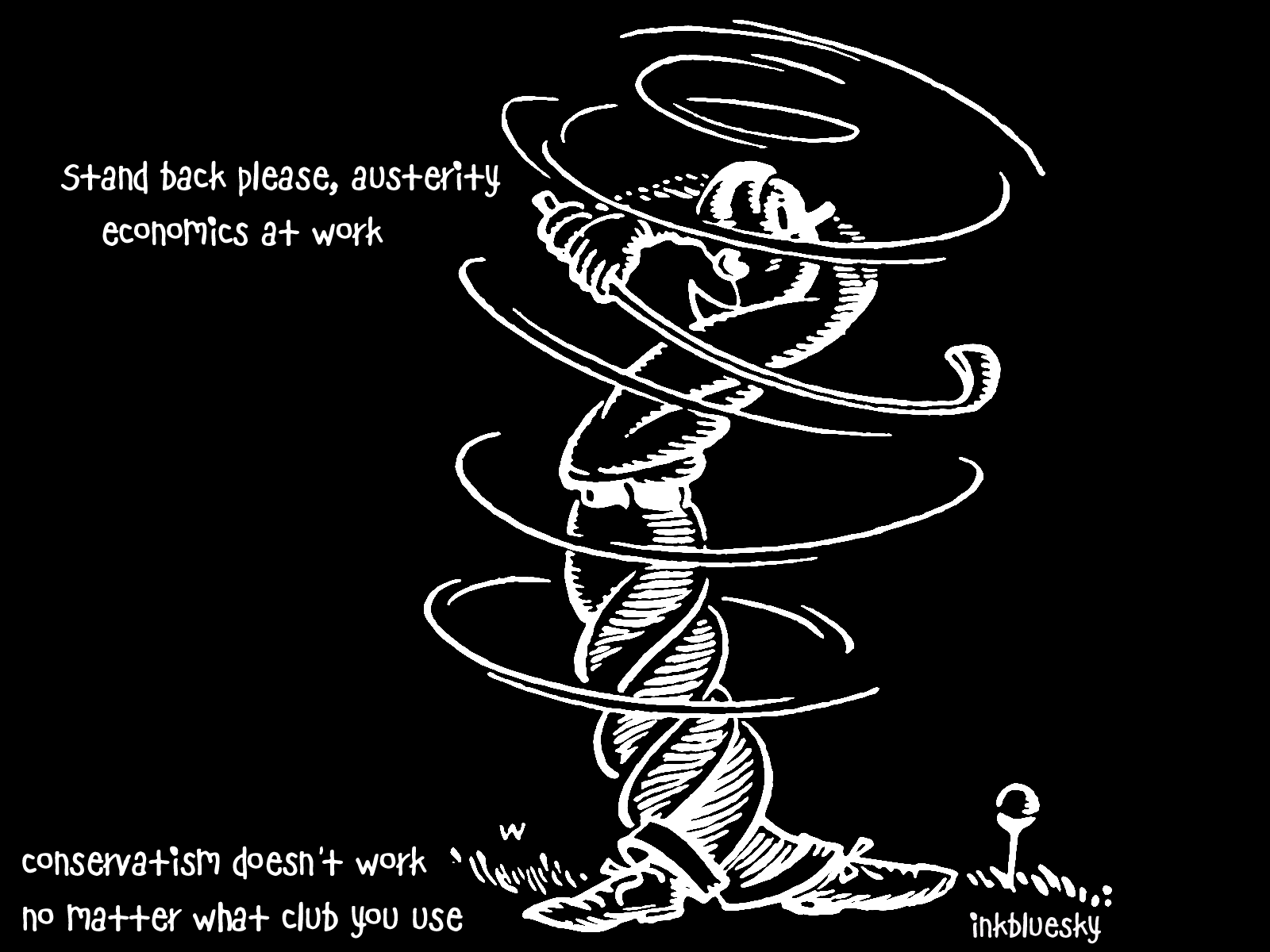
Why Do Republicans Hate America. They're Proponents of Economic Austerity, a Proven Failure as a Means of Economic Recovery


Why Do Republicans Hate America. They're Proponents of Economic Austerity, a Proven Failure as a Means of Economic Recovery

With all the theatrics going on in Washington, you might well have missed the most important political and economic news of the week: an official confirmation from the United Kingdom that austerity policies don’t work.

In making his annual Autumn Statement to the House of Commons on Wednesday, George Osborne, the Chancellor of the Exchequer, was forced to admit that his government has failed to meet a series of targets it set for itself back in June of 2010, when it slashed the budgets of various government departments by up to thirty per cent. Back then, Osborne said that his austerity policies would cut his country’s budget deficit to zero within four years, enable Britain to begin relieving itself of its public debt, and generate healthy economic growth. None of these things have happened. Britain’s deficit remains stubbornly high, its people have been suffering through a double-dip recession, and many observers now expect the country to lose its “AAA” credit rating.

One of the frustrations of economics is that it is hard to carry out scientific experiments and prove things beyond reasonable doubt. But not in this case. Thanks to Osborne’s stubborn refusal to change course—“Turning back would be a disaster,” he told Parliament—what has been happening in Britain amounts to a “natural experiment” to test the efficacy of austerity economics. For the sixty-odd million inhabitants of the U.K., living through it hasn’t been a pleasant experience—no university institutional-review board would have allowed this kind of brutal human experimentation. But from a historical and scientific perspective, it is an invaluable case study.

At every stage of the experiment, critics (myself included) have warned that Osborne’s austerity policies would prove self-defeating. Any decent economics textbook will tell you that, other things being equal, cutting government spending causes the economy’s overall output to fall, tax revenues to decrease, and spending on benefits to increase. Almost invariably, the end result is slower growth (or a recession) and high budget deficits. Osborne, relying on arguments about restoring the confidence of investors and businessmen that his forebears at the U.K. Treasury used during the early nineteen-thirties against Keynes, insisted (and continues to insist) otherwise, but he has been proven wrong.

With Republicans in Congress still intent on pursuing a strategy similar to the failed one adopted by the Brits, this is a story that needs trumpeting. Austerity policies are self-defeating: they cripple growth and reduce tax revenues. The only way to bring down the U.S. government’s deficit in a sustainable manner, and put the nation’s finances on a firmer footing, is to keep the economy growing. Spending cuts and tax increases can also play a role, but they need to be introduced gradually.

Before the last election there, which took place in May, 2010, the U.K.’s economy appeared to be slowly recovering from the deep slump of 2008-09 that followed the housing bust and global financial crisis. Just like the Bush Administration (2008) and the Obama Administration (2009), Gordon Brown’s Labour government had introduced a fiscal stimulus to help turn the economy around. G.D.P. was growing at an annual rate of about 2.5 per cent. Once Osborne’s cuts in spending started to be felt, however, things changed dramatically. In the fourth quarter of 2010, growth turned negative and a double-dip recession began. So far, it has lasted two years. While G.D.P. did expand in the third quarter of this year, the Office of Budget Responsibility, an independent economic agency that Osborne set up, has said that it expects another decline in the current quarter. For 2013, the O.B.R. is forecasting G.D.P. growth of just 1.3 per cent. With the economy so weak, the O.B.R. says that the unemployment rate will tick up from eight per cent to 8.2 per cent next year.

That austerity has led to recession is undeniable. Despite the Bank of England slashing interest rates and adopting a policy of quantitative easing, consumer and investment spending have remained depressed. Osborne places much of the blame on continental Europe, Britain’s biggest trading partner, but that’s a lame excuse. It was perfectly clear back in 2010 that Europe was headed for trouble. The proper reaction to a negative external shock is to loosen fiscal policy, not tighten it, much less tighten it violently. But Osborne was determined to go ahead with his grisly exercise in pre-Keynesian economics.

If all the pain he has inflicted had transformed Britain’s fiscal position, his policies could perhaps be defended. But that hasn’t happened. Back in 2009, the O.B.R. predicted that by the end of 2013-2014, the deficit would have fallen to 3.5 per cent of G.D.P. Now, the O.B.R. says that the actual figure will be 6.1 per cent. And since most of its forecasts have proved too optimistic, this might well be another underestimate. Even by Osborne’s preferred measure, which adjusts the headline figure for the state of the economy and doesn’t count capital spending, the deficit won’t be eliminated before 2016-17 at the earliest. The debt-to-G.D.P. ratio, which Osborne originally said would peak at about seventy per cent, has now hit seventy-five per cent, and it is forecast to come close to eighty per cent in 2015-2016. It was supposed to start falling next year. Now, it is set to keep climbing until at least 2017-2018.

A comparison with what has happened on this side of the Atlantic is illuminating. For the purposes of the natural experiment, the U.S. can be thought of as the control. In adopting a fiscal stimulus of gradually declining magnitude over the past four years, the Obama Administration has administered what was, until recently, the standard medicine for a sick economy.

As one would have expected on the basis of the textbooks, the American economy, while hardly racing ahead, has fared considerably better than its British counterpart. Between 2010 and 2012, G.D.P. growth here has averaged about 2.1 per cent. For the U.K., the figure is 0.9 per cent. What may be more surprising—at least to those of you who have been listening to the deficit hawks—is that the United States, while sticking with Keynesian stimulus policies, has also managed to bring down the size of its deficit, relative to G.D.P., almost as rapidly as hairshirt Britain has. Back in 2009, at the depths of the recession, both countries had double-digit deficits. Today, the U.S. deficit stands at about seven per cent of G.D.P., and the British deficit is about five per cent of G.D.P. But with the U.S. growing faster than the U.K,. the gap is set to close. Next year, according to the latest forecasts from the Congressional Budget Office and the O.B.R., the U.S. deficit will be considerably smaller than the U.K. deficit: four per cent of G.D.P. compared to six per cent.

Let’s go over that one more time. Having adopted the policies of Keynes in response to a calamitous recession, the United States has grown more than twice as fast during the past three years as Britain, which adopted the economics of Hoover (and Paul Ryan). Meanwhile, the gaping hole in the two countries’ budgets has declined at roughly the same rate, and next year the U.S. will be in better fiscal shape than its old ally.

This is just so much noise to the cult of conservatism. They're like modern witch doctors, they believe that dancing about howling at the moon is the solution, not rationalism and proven economic policies of the past. It doesn't phase them in the least that they cannot point to any major example of austerity causing a rapid economic recovery.

Conservatives have values? They must be joking. Christian right leader lauds homophobic Ugandan dictator. As the Ugandan Parliament revives its "Kill the Gays" bill, Republican nutbar Tony Perkins offers his support for Yoweri Museveni


Wednesday, December 5, 2012

Elitist Conservative Corporate Plutocrats talk about shared sacrifice, but the only thing they want to share is your retirement money with their wealthy friends


Elitist Conservative Corporate Plutocrats talk about shared sacrifice, but the only thing they want to share is your retirement money with their wealthy friends

The Obscenely Rich Men Bent on Shredding the Safety Net

New York magazine calls it [3] a “Mass Movement for Millionaires.” The New York Times' Paul Krugman sums up the idea [4]: “Hey, sacrifice is for the little people.”

The Campaign to Fix the Debt [5] is a huge, and growing, coalition of powerful CEOs, politicians and policy makers on a mission to lower taxes for the rich and to cut Social Security, Medicare and Medicaid under the cover of concern about the national debt. The group was spawned in July 2012 by Erskine Bowles and Alan Simpson, architects of a misguided deficit reduction scheme in Washington back in 2010. By now, the "fixers" have collected a war chest of $43 million. Private equity billionaire Peter G. Peterson, longtime enemy of the social safety net, is a major supporter.

This new Wall Street movement, which includes Republicans and plenty of Democrats, is hitting the airwaves, hosting roundtables, gathering at lavish fundraising fêtes, hiring public relations experts, and traveling around the country to push its agenda. The group aims to seize the moment of the so-called "fiscal cliff" debate to pressure President Obama to concede to House Republicans and continue the Bush income tax cuts for the rich while shredding the social safety net. The group includes Goldman Sachs’ Lloyd Blankfein, JPMorgan Chase’s Jamie Dimon, Honeywell’s David Cote, Aetna’s Mark Bertolini, Delta Airlines’ Richard Anderson, Boeing’s W. James McNerney, and over 100 other influential business honchos and their supporters.

Corporations represented by the fixers have collected massive bailouts from taxpayers and gigantic subsidies from the government, and they enjoy tax loopholes that in many cases bring their tax bills down to zero. Sometimes their creative accountants even manage to get money back from Uncle Sam. For instance, according to Citizens for Tax Justice, Boeing has paid a negative 6.5 percent tax rate for the last decade, even though it was profitable every year from 2002 through 2011.

These CEOs talk about shared sacrifice, but it seems that they don’t intend to share anything but your retirement money with their wealthy friends. As New York mag reports:

    “Most on-the-record comments are a mishmash of platitudes about shared sacrifice and working together for the good of the country. But interviews with a number of organizers and CEO council members point to a massive networking effort among one-percenters — one that relies on strategically exploiting existing business relationships and appealing to patriotic and economic instincts."

As the Fix the Debt gang moves around the country spreading their message, they are starting to attract public protests. On November 27, they were greeted in North Carolina with a rally [6] from NC Progress, which called for an end to the Bush tax cuts for the wealthiest 2 percent and told the group to keep its hands off the middle-class wallet. The fixers are often vague about their mission, and they tend to speak in coded language that conceals their actual goals. Let’s have some blunt talk about what the fixers want to do and why they want to do it – talk you're unlikely to hear in mainstream media supported by corporate advertising.

1. “Fix” means cut: When they say “fix” Social Security, they mean cut Social Security. Fixers want to convince the public that a well-managed, hugely popular program that does not add to the deficit (it’s self-funded) is somehow in crisis and requires intervention in the form of various cutting schemes. They seek this because many of the rich do not want to pay taxes for Social Security, and financiers want very much to move toward privitization of retirement accounts so they can collect fees on such accounts.

2. “Reform” means rob. When the say “reform” the tax code, they mean “make taxes even lower for the rich.” The wealthy do not pay their fair share of taxes in the United States, which is a major reason there is a large deficit in the first place. When the very wealthy pay lower tax rates than ordinary working people, the result is an increasing redistribution of income upward that puts the U.S. in the top 30 percent in income inequality out of 140 nations, according to the Central Intelligence Agency [7]. We’re a shameful #42. Income inequality is not only unfair, it’s dangerous and makes society unstable.

3.“Bipartisan” means all of the rich. Fix the Debt is a pro-business ideological movement pretending to be a bipartisan group of concerned citizens. But the group is really just a coalition for the greedy, unpatriotic rich. There are plenty of financiers and other 1 percenters in the Democratic Party, and some of them have decided to join forces with their GOP counterparts to work toward a goal that means a great deal to all of them: Making the rich even richer.

4. “Concern” means covet. There was a time, a couple of generations ago, when business leaders would not dare to go public with their desire to increase income inequality and stick it to hard-working Americans. When Owen D. Young, CEO of General Electric in the '20s and '40s, spoke to an audience at Harvard Business School in 1927, he emphasized that the purpose of a corporation was to provide a good life not only to owners, but also to employees. Corporations, he said, were meant to serve the larger goals of the nation:

    “Here in America, we have raised the standard of political equality. Shall we be able to add to that, full equality of economic opportunity? No man is wholly free unless he is both politically and economically free.”

Fast forward to 2012: Jeffrey Immelt, the current CEO of GE, is a member of the Fix the Debt Campaign, which is designed to lower the expectations of hard-working Americans. Goldman Sachs honcho Lloyd Blankfein explained this recently in a CBS interview:

     “You’re going to have to do something, undoubtedly, to lower people’s expectations of what they’re going to get, the entitlements, and what people think they’re going to get, because you’re not going to get it.”

5. “Fiscal conservative” means economically confused. Longtime Wall Street executive Steve Rattner, one of Obama’s auto bailout czars, has been using his influence to attract tycoons from the financial industry to the Fix the Debt movement. Over the last year, Rattner has been on a crusade to convince Americans that they should put aside their worries about real crises like unemployment to focus on the deficit. Rattner, like many of his cohorts, poses as a moderate whose thinking is needed to counter the advice of respected economists like Nobel Prize-winners Paul Krugman and Joseph Stiglitz, who have long been warning that defict hysteria is not only counterproductive, but based on a lack of understanding of how the economy actually works.

Political economist Thomas Ferguson, who teaches at UMass Boston and is a senior fellow at the Roosevelt Institute, described the dubious policies the fixers defend:

    “Talk about the audacity of hope! The people who brought you the Great Recession by pushing deregulation and financial leverage to insane dimensions are back. Now they propose to ‘fix the debt’ by throwing average Americans who generously bailed them out in 2008-09 over the fiscal cliff.

    One trusts that even in our money-driven political system, their transparently self-interested nonsense will be firmly rejected. There is no reason why anyone needs to do anything at all about Social Security for a long time; as even Peter Orszag admits in the fine print. It just isn't a driver of the deficit.

    The U.S. does need to reduce its spending on defense and it certainly needs to aggressively contain medical costs. But you do both of those the old fashioned way. In the case of defense, you stop plunging into wars and attend carefully to what actually is needed to defend America. In the case of medical spending, you end ‘fee for service’ schemes that reward endless tests and procedures and you vigorously pursue anti-trust and regulatory remedies. You don't simply cut Americans off from health care. It's ridiculous that we have ‘single payer’ for ailing banks, but not citizens. If you are worried about the deficit, just let tax rates rise back to the levels of the Clinton era, when growth ran far ahead of today's economy, and tax dividends, carried interest, and capital gains at the rates working Americans pay. And don't, absolutely don't, let American companies escape taxation by stashing their money abroad.”

6. "Strip-mining is not leadership." Fixers present themselves as magnanimous, responsible leaders doing what they believe is best for the country. But that’s a tough sell when you’re advocating policies that mainly benefit…yourself.
The way evil works is to shroud itself in nice sounding platitudes. In this case evil uses fine sounding words about God, country and patriotism. Never mind that what these sleazy plutocrats are selling are the opposite of what Jesus preached, has brought the country the worse recession since 1929 and is more about unhinged nationalism and moral corruption than patriotism.  

Monday, December 3, 2012

Hear That Giant Mumbling Sound, That is The Sound of The Republican Budget For 2013


Hear That Giant Mumbling Sound, That is The Sound of The Republican Budget For 2013 or why do conservatives keep hating America and loving tax cuts for lazy plutocrats

In the ongoing battle of the budget, President Obama has done something very cruel. Declaring that this time he won’t negotiate with himself, he has refused to lay out a proposal reflecting what he thinks Republicans want. Instead, he has demanded that Republicans themselves say, explicitly, what they want. And guess what: They can’t or won’t do it.

No, really. While there has been a lot of bluster from the G.O.P. about how we should reduce the deficit with spending cuts, not tax increases, no leading figures on the Republican side have been able or willing to specify what, exactly, they want to cut.
And there’s a reason for this reticence. The fact is that Republican posturing on the deficit has always been a con game, a play on the innumeracy of voters and reporters. Now Mr. Obama has demanded that the G.O.P. put up or shut up — and the response is an aggrieved mumble.

Here’s where we are right now: As his opening bid in negotiations, Mr. Obama has proposed raising about $1.6 trillion in additional revenue over the next decade, with the majority coming from letting the high-end Bush tax cuts expire and the rest from measures to limit tax deductions. He would also cut spending by about $400 billion, through such measures as giving Medicare the ability to bargain for lower drug prices.

The point is that when you put Republicans on the spot and demand specifics about how they’re going to make good on their posturing about spending and deficits, they come up empty. There’s no there there.

Republicans have howled in outrage. Senator Orrin Hatch, delivering the G.O.P. reply to the president’s weekly address, denounced the offer as a case of “bait and switch,” bearing no relationship to what Mr. Obama ran on in the election. In fact, however, the offer is more or less the same as Mr. Obama’s original 2013 budget proposal and also closely tracks his campaign literature.

So what are Republicans offering as an alternative? They say they want to rely mainly on spending cuts instead. Which spending cuts? Ah, that’s a mystery. In fact, until late last week, as far as I can tell, no leading Republican had been willing to say anything specific at all about how spending should be cut.

The veil lifted a bit when Senator Mitch McConnell, in an interview with The Wall Street Journal, finally mentioned a few things — raising the Medicare eligibility age, increasing Medicare premiums for high-income beneficiaries and changing the inflation adjustment for Social Security. But it’s not clear whether these represent an official negotiating position — and in any case, the arithmetic just doesn’t work.

Start with raising the Medicare age. This is, as I’ve argued in the past, a terrible policy idea. But even aside from that, it’s just not a big money saver, largely because 65- and 66-year-olds have much lower health costs than the average Medicare recipient. When the Congressional Budget Office analyzed the likely fiscal effects of a rise in the eligibility age, it found that it would save only $113 billion over the next decade and have little effect on the longer-run trajectory of Medicare costs.

Increasing premiums for the affluent would yield even less; a 2010 study by the budget office put the 10-year savings at only about $20 billion.

Changing the inflation adjustment for Social Security would save a bit more — by my estimate, about $185 billion over the next decade. But put it all together, and the things Mr. McConnell was talking about would amount to only a bit over $300 billion in budget savings — a fifth of what Mr. Obama proposes in revenue gains.
The point is that when you put Republicans on the spot and demand specifics about how they’re going to make good on their posturing about spending and deficits, they come up empty. There’s no there there.

And there never was. Republicans claim to be for much smaller government, but as a political matter they have always attacked government spending in the abstract, never coming clean with voters about the reality that big cuts in government spending can happen only if we sharply curtail very popular programs. In fact, less than a month ago the Romney/Ryan campaign was attacking Mr. Obama for, yes, cutting Medicare.

Now Republicans find themselves boxed in. With taxes scheduled to rise on Jan. 1 in the absence of an agreement, they can’t play their usual game of just saying no to tax increases and pretending that they have a deficit reduction plan. And the president, by refusing to help them out by proposing G.O.P.-friendly spending cuts, has deprived them of political cover. If Republicans really want to slash popular programs, they will have to propose those cuts themselves.

So while the fiscal cliff — still a bad name for the looming austerity bomb, but I guess we’re stuck with it — is a bad thing from an economic point of view, it has had at least one salutary political effect. For it has finally laid bare the con that has always been at the core of the G.O.P.’s political strategy.

Republicans want to cut Medicare and Social Security, the two big safety net programs, but they can only hint at their desire to see grandma and grandpa living under a bridge because the American public might catch on that these really are dangerous right-wing ideologues that hate everyone, but their corporate cronies.

What liberal media? CBS Analyst Frank Luntz Praised Conservative Anti-American Radical Paul Ryan(R-WI) While His Firm Received Money From His Campaign


Thursday, November 29, 2012

Map and field


McCain (R-AZ) and Graham(R-SC) Look Like Anti-American Fools in Unfounded Attacks on Susan Rice Instead of the Terrorists


McCain (R-AZ) and Graham(R-SC) Look Like Anti-American Fools in Unfounded Attacks on Susan Rice Instead of the Terrorists

The Republican gang-up on Susan Rice is a puzzler. Not only does it make no policy sense to blame the U.N. ambassador for any aspect of the killings at Benghazi, Libya, it makes no political sense either.

So far five GOP senators have objected to the idea of President Obama nominating Rice to be the next secretary of state. Two of those senators—John McCain and Lindsey Graham—are party leaders on foreign policy and frequent visitors to TV news studios. This is what makes the campaign particularly bizarre. Their case against her is not just unusually flimsy and transparently partisan; It also shines a glaring light on their own brazen hypocrisy (something most politicians do all they can to avoid).

First, the facts. The weekend after terrorists attacked the U.S. Consulate in Benghazi, killing four officials including the ambassador to Libya, Susan Rice went on the talk shows to deliver the administration’s position. The official line at the time was that the attack began as a spontaneous protest—similar to the one that sparked violent demonstrations outside U.S. embassies in Egypt and elsewhere—to an American-made anti-Muslim movie that had gone viral on the Internet. As it turned out, and as she explained in a meeting with senators on Tuesday, Rice was only reciting an unclassified “talking points” sheet prepared by the U.S. intelligence community. Acting CIA Director Michael Morrel, who joined Rice at the meeting, affirmed that those talking points were consistent with classified intelligence reports at the time. He also noted that, to the extent that Rice’s authorized comments differed from the top-secret version (for instance, they left out the finding that a jihadist group was involved in the attack), it was for security reasons.

Was this an intelligence foul-up, worthy of a congressional hearing or two? Possibly. Was there a scandalous cover-up? Doubtful. Whatever an investigation turns up, is all this a valid excuse for denying higher office to the ambassador who went on TV and recited the intelligence community’s talking points? Of course not. More than that, the five senators must know it’s absurd, so trumped-up are their rationales for thinking otherwise.

Here’s what McCain said on Fox News, after the meeting with Rice and Morrel:

We knew in hours of all the details when we got bin Laden, they’re making a movie out of it, and [yet] here we are, ten weeks later [i.e., after the Benghazi attack] finally our ambassador to the United Nations, who appeared on every national Sunday show, is now saying that she gave false information concerning how this tragedy happened.

I don’t know if this is, as Talking Points Memo Editor Josh Marshall put it, the “stupidest thing McCain ever said,” but it’s probably one of the three or four most desperate. First, we knew everything about the raid on Bin Laden’s compound so quickly because (this should be really obvious, senator) the commandos who did it, our own Navy SEALs, were there. They streamed it live. By contrast, the details of a firefight at a remote outpost in Libya are more likely than not to be shrouded in confusion and ambiguity, for a while. Second, giving “false information,” which is legal parlance for “lying,” is an over-the-top characterization of what Rice did. Third (and this really should shut the door on the whole business), when McCain picked Sarah Palin as his running mate in the 2008 presidential election, he forever disqualified himself from commenting on any nominee for any high office—and the media should treat any such comments accordingly.

Sen. Graham has made many foolish remarks in this sorry saga as well, but the jaw-dropper is his comparison, also made after Tuesday’s meeting, between Rice and John Bolton, who was President George W. Bush’s controversial (and ultimately rejected) nominee for U.N. ambassador. As Graham summarized the Bolton fight, “Democrats dug in their heels and said, ‘We’re not going to vote, we’re not going to consider this nomination until we get basic answers to our concerns.’ ” His point, presumably, was that he plans to do the same if Obama nominates Rice for secretary of state.

There are several differences between Bolton and Rice. For instance, Bolton had made highly critical statements about the legitimacy of the United Nations—and even of international law. Many Democrats and a few Republicans thought these were inappropriate sentiments for a U.N. ambassador. The Democrats held up Bolton’s nomination, pending the release of documents concerning precisely those sentiments—not some peripheral matter over which the nominee had no say or control.

Sen. Kelly Ayotte (R-N.H.)—who seems to be auditioning for the “third amigo” now that Sen. Joseph Lieberman (I-Conn.) is retiring, leaving McCain and Graham bereft of a traveling companion—says she will try to block the confirmation of any nominee for secretary of state. “My view is we should hold on this until we get sufficient information” on Benghazi, she said. Well, at least she’s honest about her motives.

McCain and Graham both lied to America about WMD and manipulated the nation into a costly and unnecessary war in Iraq. They have no credibility. They have never apologized or retracted their lies. Why they have not been tared and feathered and sent to live in exile is the only real mystery. There have been attacks on U.S. embassies during the Bush 43 and Reagan administrations, many of these same conservative hypocrites did not go looking for someone to scapegoat in those Republican administrations, Conservative Republican Freak Whitewashes Bush's History To Bash Obama Over Embassy Attack

Gun Enthusiast Kills 17-Year-Old for Playing Loud Music; Lawyer Says He Acted "Very Responsibly"

Extending Unemployment Insurance Would Create 300,000 Jobs Next Year

Scientific advice in the EU to ensure the sustainability of populations of sharks in oceanic waters

The original news release is in Basque, this is a Google translation,  Scientific advice in the EU to ensure the sustainability of populations of sharks in oceanic waters


Scalloped Hammerhead wallpaper

A committee led by AZTI-Tecnalia will provide scientific advice to policy makers in the European Union fishing, shark fishing is sustainable.

Researchers in the Basque technological center, in addition to the advisory group are: the Spanish Oceanographic Institute (EOI) scientists, the French Research Institute of Operation Sea (IFREMER), the French Research Institute for Development (IRD) and the Fisheries and Marine Research Institute of Portugal (ujob). Within the European Community action plan to protect sharks in the work of the European Commission Directorate-General for Maritime Affairs and Fisheries financing and has a duration of 15 months.

The Sharks are caught in fishing nets, and fishing as well as for other types of fish to catch fish in different fishing grounds. Shark fishing in the oceans has increased significantly in recent years, and, therefore, it is necessary to know their status. To this end, the European Commission called CPOA-Shark Action Plan was established in 2009. The main objective of the Plan is to contribute to the European Union fishing fleet to sustainable shark fisheries, as well as the waters of the community, and internationally. The project will examine specifically to catch tuna fishing activities that have the effect of shark populations, taking into account all types of activities, such as the fishing industry, the coastal fishing craft. With this intention, the world's largest tuna fleets in the Atlantic Ocean, the Indian and the Pacific catches of shark species found. Capturing regional fisheries management organization (CCAA) are managed atunketariek (ICCAT in the Atlantic, Indian and IATTCk IOTC and WCPFCk Eastern and Western Pacific, respectively).

Atlantic, Indian and Pacific populations of sharks at sea level is not suitable for scientific knowledge. So, the plan is to get specialized technical advice on fishing sharks and shark species, their role in the marine ecosystem knowledge. AZTI-Tecnalia specialists and consultants from other schools involved in the fishing industry in a balanced way that will help the animals.

AZTI-Tecnalia is leading this project, "Information has been received from the three largest tuna fleet fishing in ocean-caught shark species, effort, size-distribution of fish, about the biology and ecology. The idea of ??the fishing grounds, the missing data is to identify and respond to the priorities, the evaluation of these populations to ensure sustainable management, "says Hilario Murua, AZTI-Tecnalia biologist and" European Community Action Plan for the protection of Sharks "on the scientific advisory committee is responsible for same. "In the second phase, these vulnerable populations to ensure the sustainability of fishing grounds to propose a framework for investigation and follow-up."
Capture a significant increase in

Shark-fishing industry in the world has increased significantly: in 1980, 600,000 tonnes were caught in 2003 and was caught up by 900,000 tonnes. It was a historical peak in 2007, fell to approximately 800,000, and in 2008, 750,000. This trend is due to increase in demand for shark products, mainly to the edges, but the meat, skin and cartilage as well, especially in the Asian markets.

Small coastal sharks caught by European fleets have traditionally, and the scientific community has sufficient information on these fisheries. However, in recent years has increased exploitation of deep sea sharks in the Atlantic Ocean, the Pacific and the Indian, and receive detailed information on this is not so. This further adds to this problem: too many sharks are caught atunketariek countries, particularly in Asia, the fishing fleet, which operates in the oceans. The history of these ships have been caught in tuna and swordfish, and sharks are caught more oceanic.

Sharks are particularly vulnerable to over-fishing, mainly because of low reproductive capacity. Therefore, excessive fishing and other human impacts on the species of small capacity.