
Showing posts with label pathological liars. Show all posts

Wednesday, November 7, 2012

The USA Voted For Real Values and Re-elected President Obama


The USA Voted For Real Values and Re-elected President Obama

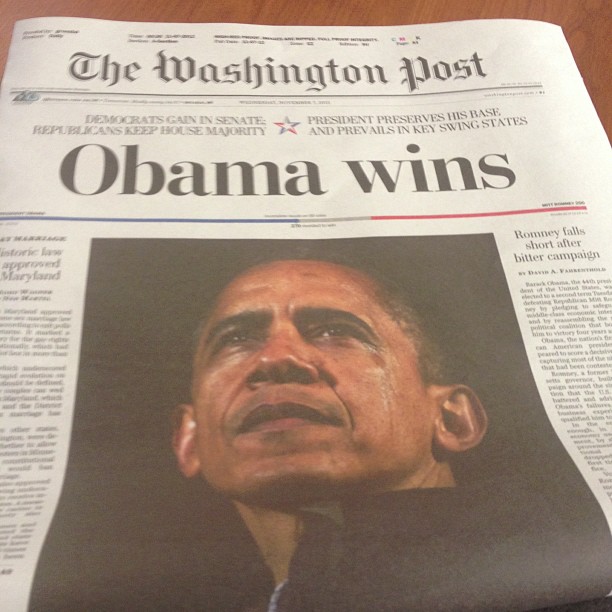
President Obama's re-election was never much in doubt, except perhaps briefly when he took a plunge after the first debate and we didn't know where the bottom was. But by the end of the campaign, Sam Wang of the Princeton Election Consortium was giving Obama a better-than-99% chance of winning. Nate Silver of the New York Times, more cautious, put the odds Tuesday at about 90-10 in favor of Obama.

Those who point to the popular vote as evidence of a very tight contest, as much of the media did before the election, should consider two things: first, that is not the way the game is played here (unfortunately). If the popular vote determined the presidency, the Obama team would have put more resources into big states like California and New York to ensure that Obama would win the popular vote by a wider margin. Instead, the resources went into swing states, in order to ensure a victory in the electoral college vote. ( this was written before some votes were counted: President Obama won the popular vote and the electoral college)

Second, the country is nowhere near as closely divided as the popular vote indicates. That's because non-voters, who were about 43% of the electorate in 2008, favor Obama by a margin of about 2.5 to one.

Indeed, the resources and political power that Republicans mobilized in an effort to deny millions of Americans their right to vote, and to suppress voter turnout, raise serious questions about their legitimacy as a political party. A legitimate political party does not rely on preventing citizens from voting, in order to prevail at the polls, any more than a legitimate government relies on repressing freedom of speech or assembly in order to remain in power.

How did Obama win?

In this election, as in almost every presidential election for decades, the biggest block of swing voters has been white working-class voters (however defined: for example, without college education). No Democratic candidate has won a majority of white voters for decades, since the Republicans adopted their "southern strategy" in the wake of historic civil rights legislation, and became the "white people's party". (In fact, Obama did better among white voters in 2008 than John Kerry did in 2004 – his racial identity was not a handicap because most voters who wouldn't vote for an African American don't vote for Democrats.) But in this contest, Obama had to win enough of the white working-class voters in battleground states to win the election, while winning about 95% of African-American voters and a large majority of Latino voters.

This he did primarily by making a populist appeal to working-class voters, more populist than any major party presidential nominee in decades. In the last debate, which was supposedly about foreign policy, Obama repeatedly referred to Romney as someone who wants to make sure that rich people "don't play by the same set of rules" as everyone else. Throughout the campaign, his team attacked Romney for being a rich, unscrupulous politician who didn't care about working people.

Of course, it helped that Romney fit the stereotype – a rich corporate raider, a private equity fund CEO, who said he "like[s] being able to fire people", and paid less of his income in taxes than millions of working Americans. His infamous secretly-recorded remark dismissing 47% of Americans as moochers – "my job is not to worry about those people" – was a gift from God, and became one of the Obama campaign's most effective TV ads.

But for those who have followed Obama's political career, his re-election was always extremely likely – and indeed, it would hardly have been in jeopardy if he had actually debated in the first debate. We knew that he would be as populist as he needed to be in order to win. Even with 23 million people still unemployed or underemployed (as Romney repeated endlessly), it's not that hard to convince a lot of working-class voters that Romney and his party don't have their interests at heart – if you are willing to make the kind of economic populist appeal that Obama ultimately made.

The downside risk, for a candidate, is the potential loss of rich campaign contributors and media; but Obama was willing to take these risks in order to win. This was a historic difference from previous presidential campaigns: Democratic candidates such as Michael Dukakis and Al Gore flirted briefly with economic populist appeals, but backed off in the face of media pressure.

The media are a huge factor in most elections in the US, and outside of Fox News and the rightwing press, most of the major news outlets were more sympathetic to Obama than to Romney. They still helped Romney quite a bit, however, especially with swing voters, with poor reporting on key economic issues. Most Americans didn't know that the federal stimulus had created an estimated 3m jobs; in fact, they didn't even distinguish the stimulus from the unpopular federal bank bailout. They didn't understand the benefits that people would derive from Obama's healthcare legislation. They didn't know that they'd had their taxes cut under Obama. And millions believed the hype that federal deficit spending and the US public debt were major problems. (For the record, the US currently pays less than 1% of GDP in net interest annually on the federal debt – less than it has paid during the past 60 years.)

The confusion on economic issues was probably the most important influence on swing voters, who supported Romney against their own economic interests, thinking that the economy might improve if he were elected. For this, and other misunderstandings, we can thank the major media, although we should also include the public relations blunders made by the Obama team. Perhaps the biggest strategic error was President Obama's refusal to go after Romney's proposal to cut social security, thereby losing the majority of senior citizens' votes (a big vote in swing states like Virginia and Florida), which he could potentially have won by defending America's most popular anti-poverty program.

Obama's silence on social security is a bad omen for the future of his second administration, when – facing almost immediately the "fiscal cliff" – political, media, and business leaders will be pressing for a "grand bargain" on budget issues that will screw the vast majority of Americans. It will take a lot of grassroots pressure to prevent the worst outcomes: likewise, to get us out of Afghanistan and to prevent another disastrous war, this time with Iran. Obama's foreign policy has been mostly atrocious and the never-ending "war on terror" continues to expand, while most Americans' living standards have been declining.

It's going to be an uphill fight for progress, but it could have been a lot worse.

Like an increasing number of Americans I'm not sure what conservatives like Romney stand for. They chant 'small government" like a mantra, but when you look at the details what they mean is gutting social safety net programs like Medicare and Social Security, doing away with food inspections, gutting safety standards for water so industry can dumb as much toxins as they like ( that is also how conservative Republicans define freedom - just let business give America the shaft in the name of increasing the wealth of people who are already wealthier than 90% of the population). Conservatives deserve to lose every office they were running for. They wave the flag a lot, but have seized to stand for patriotism, and instead stand for hateful unhinged nationalism.

A Letter to Conservatives

Saturday, November 3, 2012

Conservatives Who Think That Women Should Have Fewer Rights Than Men May Cost Republicans Victory, But Save America From A Radical Agenda


Conservatives Who Think That Women Should Have Fewer Rights Than Men May Cost Republicans Victory, But Save America From A Radical Agenda

What if misogyny ends up costing Republicans the Senate? Judging by the polls in the final days before the election, this is not a crazy proposition — especially if “gaffes” on abortion, rape and contraception are equated by the electorate with extremism, repelling even ideologically sympathetic voters.

Just look at Indiana, a state that is choosing between two “pro-life” candidates, one of whom is a Democrat who has voted for House Republicans’ most restrictive legislation on reproductive rights. Still, Joe Donnelly managed to avoid doing what Richard Mourdock did – getting famous for talking insensitively about rape. They’ve been tied or within inches of each other for weeks, but as of today, the first post-rape-comment poll, Mourdock is down 11 points. Meanwhile, Mourdock’s rape-talking fellow traveler in Missouri, Senate candidate Todd Akin, is locked in a race that was never supposed to be competitive, and a cash infusion may come too late to save him. And in Connecticut and Massachusetts, both abortion and contraception have been used to pummel relatively moderate Republicans with the ever-rightward agenda of the national party, and for that reason and more, it’s looking like Democrats will prevail.

This is about more than the so-called gender gap, though women do tend to vote disproportionately to our share in the population and historically favor Democrats. And it’s about more than “pro-life” and “pro-choice,” where, at least as far as those fuzzy words go, the former has a slight edge in polling. When abortion conversations turn to rape, exceptions for which are broadly, if inconsistently, supported by voters, they also suddenly become about a broader callousness and indifference to suffering, one that jibes with messaging about slashing Medicare and Medicaid. Voters drifting away from Mourdock would probably never use the word “misogyny,” but as I’ve said, as the Republican agenda on sex and reproduction gets explained in full, we’re hearing very little about compassion for fetal life and a lot about women having sex.

Pro-choice activists have been saying this for years, but didn’t get much credence until elected Republicans gave a larger platform for marginal and largely discredited views — rape victims can’t get pregnant (Akin); exceptions to save a woman’s life are never needed (Rep. Joe Walsh); consensual sex, and getting pregnant from it, is as shameful as rape (GOP Senate candidate Tom Smith, who hasn’t been able to close the deal in Pennsylvania). The same goes for defunding Planned Parenthood and repealing Obamacare, or at the very least getting rid of the birth control coverage in it — these days, virtually uncontested across Republicans in office or running for it. That may work well in a House race, but it’s proving a tougher sell statewide — and, judging by Romney’s ads soft-pedaling his stances on abortion and contraception, nationally as well.

If you want to know where this all came from or where it’s going, check out Emily Bazelon’s profile of the Americans United for Life president in the New York  Times magazine. AUL has been as influential as any group in crafting the state-level abortion restrictions and rhetoric around them, taking the murky anti-choice rhetoric and mainstreaming it in a palatable and reasonable-sounding way. Yoest “believes that embryos have legal rights and opposes birth control, like the IUD, that she thinks ‘has life-ending properties.’” (She can think that, but it doesn’t make it medically accurate.) She refuses to discuss a study showing that the abortion rate drops dramatically when you make long-acting reversible birth control — like the IUD — free to women who want it, mimicking Obamacare’s full coverage under insurance. And yet she knows that when you talk about birth control and abortion as connected to women’s reproductive and sexual autonomy, the anti-choice side loses. She said as much on PBS, Bazelon notes: ““It’s really a red herring that the abortion lobby likes to bring up by conflating abortion and birth control … Because that would be, frankly, carrying water for the other side to allow them to redefine the issue in that way.”

Instead of outright repealing the 19th Amendment( guaranteeing women the right to vote) and other progressive legislation that have leveled the playing field over the years in one fail swoop, Republicans have been pretty successful in chipping away at the rights of women to be full citizens. And Mittens is no friend to more than have the country. He thinks conservatives and big government should control women,Top 6 Lies Romney Has Told Women in an Election Season Full of Whoppers, Mitt has assembled a binder full of bs on issues that matter to more than half the population

Republicans are resorting to some weird extortion to get the vote, The GOP Will Destroy America If We Reelect Obama, So We Must Let the GOP Win


Sunday, October 28, 2012

What is a Nightmare? The Day After Morally Bankrupt Mitt Romney is Elected


What is a Nightmare? The Day After Morally Bankrupt Mitt Romney is Elected

Despite the difficulty nailing down a chameleon-like candidate's positions, we've tried to discern some of the economic measures that Romney would likely champion if he wins. We'll follow up with a look at non-economic policies in the coming days.

1. The Romney-Ryan Budget

Let's assume, for the moment, that the Republicans take the Senate.

Mitt Romney has at times embraced Paul Ryan's “roadmap [3],” and he's also distanced himself from it. But there will be quite a bit of pressure from conservative activists and the Republican House to enact something along the lines of the roadmap.

There are two things to understand about Paul Ryan's budget. First, it has been carefully written so that most of its provisions can be passed under a process known as budget reconciliation, which requires only a simple majority of votes in the Senate. Second, it is a right-wing fantasy that, if enacted as written, would trigger a major drop in employment and send the economy into a tailspin. Its cuts are so deep, and would effect so many constituents – including traditionally Republican constituents – that it would have to be modified. It's one thing to campaign on such a plan and another to govern with it.

What does it do? According to the Center for Budget and Policy Priorities [4], “by 2050, most of the federal government aside from Social Security, healthcare and defense would cease to exist, according to figures in a Congressional Budget Office analysis.”

    The CBO report, prepared at Chairman Ryan’s request, shows that Ryan’s budget path would shrink federal expenditures for everything other than Social Security, Medicare, Medicaid, the Children’s Health Insurance Program (CHIP), and interest payments to just 3¾ percent of the gross domestic product (GDP) by 2050. Since, as CBO notes, “spending for defense alone has not been lower than 3 percent of GDP in any year [since World War II]” and Ryan seeks a high level of defense spending — he increases defense funding by $228 billion over the next ten years above the pre-sequestration baseline — the rest of government would largely have to disappear. That includes everything from veterans’ programs to medical and scientific research, highways, education, nearly all programs for low-income families and individuals other than Medicaid, national parks, border patrols, protection of food safety and the water supply, law enforcement, and the like.

Ryan has already modified his plan in response to the outcry over a CBO analysis that found future retirees would face $6,400 more in out-of-pocket healthcare costs. We can expect further modifications because no Republican administration is actually going to slash veterans' benefits to the bone, to name just one example. It's untenable, but that doesn't mean President Romney wouldn't push through something moderately less damaging.

2. Tax Cuts or rewarding rich people for being rich, not for work.

Romney promises to slash taxes by 20 percent across the board, maintain deductions enjoyed by the middle class and not decrease the share of taxes paid by the wealthy (or anyone else). We know Romney's math simply doesn't work [5] – it's impossible. http://www.cbpp.org/cms/index.cfm?fa=view&id=3708

But while the whole doesn't add up, Romney could get a number of those provisions passed, like eliminating the inheritance tax, the Alternative Minimum Tax (which hits high earners), and certainly keeping the “Bush tax cuts” on income investment in place.

When a candidate presents a plan that literally does not add up, it's not possible to predict what he'd do with any specificity once in office. Based on the recent history of GOP governance, the sharp right turn the party's taken in recent years and Mitt Romney's own background, one can be reasonably confident that Romney would cut taxes on high earners and corporations, but projecting by how much – and whether it would be financed through deficits, additional cuts or higher taxes on the middle class – is an exercise in reading the tea leaves.

3. ObamaCare

Mitt Romney has pledged to repeal ObamaCare and replace it with a plan that, while light on details, would be centered around health savings accounts and insurance deregulation. Employers would throw some cash into the accounts, people would get some tax breaks and then the miracle of the free market will supposedly swoop in and fix our broken healthcare system.

Repealing ObamaCare may not be as cut-and-dried as the Republican base has been led to believe, however. Contrary to the mythology surrounding the program, the Congressional Budget Office projects ObamaCare to reduce the deficit by hundreds of billions of dollars in the coming decade and beyond. According to Senate rules now in effect, the reconciliation process cannot be used to pass anything that increases the budget deficit 10 years from now.

There are ways to get around procedural rules, and failing that, the executive branch has a lot of discretion in terms of implementation. A Romney adviser told Politico [6] that if the Dems hold the Senate, “we would just have to try to grind out changes by starving ObamaCare through regulations.”

If Romney is able to repeal ObamaCare and replace it with his plan, a study by the Commonwealth Fund [7] projects that it will leave 72 million uninsured by 2022 – 45 million more than is projected under ObamaCare.
A tragic irony is that Romney's healthcare plan would likely prove to be a fatal blow [8] to the best thing he's ever accomplished in public service – the “RomneyCare” scheme in Massachussetts.

4. Medicare

There is little doubt that Mitt Romney would pursue a variant of Paul Ryan's plan to voucherize Medicare for those who retire after a given date (in Ryan's plan it's 2023). Seniors would at first get a voucher sufficient to cover the cost of a private insurance plan comparable to Medicare. But the value of that voucher would only increase by the rate of overall economic growth plus 0.5 percent. The problem is that healthcare costs grow a lot faster. The difference would be borne by seniors themselves – it does nothing to contain healthcare costs, it just shifts them from the government to the backs of individuals.

When the CBO scored Ryan's first plan in 2011, it found that seniors would face an additional $6,400 in out-of-pocket expenses by 2022. After Democrats jumped on that figure, Ryan released a new plan, which called for Congress to come up with some unspecified remedy. CBO wasn't able to score it, but said [9] “beneficiaries might face higher costs.”

Ryan would also raise the retirement age to 67, a measure Romney has endorsed.

It's entirely possible that a President Romney would sweeten the deal a bit to make those numbers look better in the medium-term, but any voucher plan that doesn't keep up with the actual increase in healthcare costs achieves the same thing -- eventually shifting part of the burden onto seniors.

5. Medicaid

While Medicare has received the most attention, Ryan's plan for Medicaid, which Mitt Romney has endorsed, would be a more devastating hit to our threadbare social safety net.

Ryan's plan would turn Medicaid into a block-grant program, cap its funding – cutting $800 billion from the program over the next decade -- and then send it to the states to administer. The first problem is that states – presumably red states – would be free to make it harder to qualify, and the second is that the program wouldn't have the funding flexibility to enroll more people during economic downturns.

Medicaid serves 60 million Americans, about 10 million more than Medicare. Most people think Medicaid only serves the poor, but Medicaid is indespensible for the disabled, especially the severely diabled who require a lot of care. It also covers Medicare's out-of-pocket expenses for retirees with limited incomes.

6. Social Security

George W. Bush learned the hard way that privatizing Social Security is a great way to make voters hate you. That's why the Ryan plan is quite vague. It calls for "action on Social Security by requiring both the President and the Congress to put forward specific ideas and legislation to ensure the sustainable solvency of this critical program." The budget does tout "reforms that take into account increases in longevity, to arrest the demographic problems that are undermining Social Security's finances” – which sounds a lot like raising the retirement age.

7. State Children's Health Insurance Program (S-CHIP)

S-CHIP is likely to be hit hard under a Romney administration if he has a Republican Congress. Under the Ryan plan, S-CHIP could only increase by the rate of inflation, which again, is much slower than the projected rate of healthcare cost inflation. The CBO looked at Medicaid and S-CHIP together, and found that spending on the two programs would be about 70 percent less than currently projected by the year 2050 under Ryan's "roadmap."

8. The Rest

If the Republicans run the field in a big win, expect a lot of talk about a constitutional amendment capping federal spending at a given share of our gross domestic product. It will only be talk. It's a right-wing fantasy of a policy that can only be enacted with a constitutional amendment, which isn't going to happen.

That doesn't mean there won't be deep, deep cuts to non-defense discretionary spending under a Romney administration. Under the Ryan plan, non-defense discretionary spending would be on a downward trajectory leading to 39 percent less funding than currently projected by the year 2040. What is “non-defense discretionary spending”? Well, about 40 percent is education, training and research, and the rest is veterans' programs, various programs for low-income families, public safety and disaster response and the like. It's basically government, absent the Pentagon budget, Social Security and Medicare.

9. If Dems Have 40-50 Seats in Senate (With Ryan the Tie-Breaking Vote)

Although he has been vocal in his opposition in the past [10], there's a good chance that as Senate Majority Leader, Mitch McConnell, R-Kentucky, might embrace filibuster reform – dropping the number of votes needed to overcome a filibuster from 60 -- if the Dems hold a minority in the upper chamber.

Either way, one thing not to expect in this scenario is Senate Democrats turning the tables on the GOP and blocking their legislative agenda at every turn. That's a strategy the Republicans can undertake because their overarching narrative is that governent doesn't do anything right – it ultimately works to their benefit when they can “prove” that theory by rendering Congress incapable of action. Democrats still adhere to the idea that good governance can improve our society, so they can't play the same game and get away with it.

10. If Dems Hold Senate

If the Dems hold the Senate they will act as a firewall against the radical restructuring of the public sector promised by the Ryan budget.

That means maintaining the status quo, more or less, at least through 2014, with one painful exception. Cheered on by the Beltway media, the Democrats, having embraced the non-existent recommendations of the Simpson-Bowles commission (the chairmen drafted recommendations but the gang of 18 didn't vote to approve them), would almost certainly be willing to strike a “grand bargain” with President Romney along those lines.

The only question is whether Speaker Boehner (or Cantor?) would have any trouble coming up with the votes for a “balanced” deficit reduction deal – for a deal that raises some new revenues. If history is any guide, even the most ideological House Republicans will support a Republican president in such an effort.

Currently, non-defense discretionary spending is expected to hit its lowest level since 1962, and Simpson-Bowles would cut deeper still – with a 3:1 ratio of spending cuts to tax increases. That means programs that help the poor and middle class will be on the chopping block. Simpson-Bowles also called for a hike in the Social Security retirement age, despite the fact that life expectancies have only increased significantly for the well-to-do who don't rely on the program as heavily as working people and the poor.

The U.S. is still the richest nation in the world ( maybe 2nd, some economists think China passed us) yet Romney-Ryan would have half the population living in their own 3rd world like conditions. Conservatives talk about imgiinary death panels - the reality is that a conservative president and a conservative Congress will literary mean the deaths of millions of senior citizens and disabled. besides their wacky UnAmerican ideology, why are conservatives going to try and pass this kind of cruel legislation/ Because they do not want to rise taxes on billionaires who are complaining they're not making enough money. Seriously. These same billionaires and multimillionaires are also threatening to fire employees if they do not vote for immoral Mitt.

Paul Ryan Takes a Side in the War on Poverty: He's Against What Works

Condi Rice Pours Cold Water On ‘Benghazi-Gate’

The Republican propaganda channel and Anti-American Fox New's John Roberts Whitewashes Romney's Position On Auto Rescue

Saturday, September 8, 2012

How the Media Enables Paul Ryan's Pants On Fire Lies


How the Media Enables Paul Ryan's Pants On Fire Lies

The myth of “Paul Ryan, serious budget wonk” has a history that dates since the 2010 Tea Party sweep of the elections, at least into the Bush administration. It's been untrue [3] for at least that long.

There were magazine stories [4] of the Young Guns of the GOP—Ryan, Eric Cantor and Kevin McCarthy. They even chose that title [5] to brand themselves [6], comparisons to the 1980s cowboy movies notwithstanding. If they were in a boy band, Ryan would've been the Serious One while Cantor was the Wisecracking One, and McCarthy, well, he was the One Everyone Forgets About. Other Serious Young Men gave Paul Ryan gravitas--even those ostensibly across the aisle, like Ezra Klein [7], who wrote in 2011, “Ryan is the kind of politician I fundamentally like. He’s smart, policy-oriented and willing to take political risks.” In 2010 Klein titled a blog post “The virtues of Ryan's roadmap [7],” calling Ryan's plan (the one that gutted Medicare) “a more honest entry into the debate.”

Klein at least has come around to become one of the stronger voices arguing that Ryan isn't a deficit [8] hawk but an ideologue bent on privatization [9]. But plenty of others are still pretending that the vice-presidential nominee is willing to have a serious debate on policy. It's no secret that Fox News is letting Romney and Ryan get away with anything, but it's commentators in the mainstream media that do the most damage. Reporters love a ready-made narrative. Writing on a deadline, it's easy to slot in conventional descriptors and fit politicians into stock roles. We've been told Ryan is a serious budget nerd, and the more it gets echoed, the more it will continue to be echoed. Here we bring you seven media enablers of the Paul Ryan myth.

1. Howard Kurtz, Daily Beast

Howard Kurtz [10] is supposed to be a media critic, which makes it even more grating that he's fallen into the same trap as most of the rest of the mainstream media when it comes to Ryan's bona fides.

“True to his reputation as one of the GOP’s leading intellectuals,” Kurtz wrote of Ryan's RNC appearance, “it was something of a wonky speech sprinkled with folksy references—such as one to his hometown of Janesville, Wisc., where 'a lot of guys I went to high school with' worked at a GM plant that shut down.”

That's not the only time Kurtz alludes to Ryan's wonkiness without actually mentioning any of Ryan's policy points—aside from pointing out that Ryan's misleading everyone by beating up on Obama's Medicare cuts without mentioning his own slash-and-burn plan for healthcare for the elderly. He also mentions the Janesville line without pointing out that it too was one of Ryan's biggest whoppers of the night, trying to blame the president for closing a plant that shut down in 2008 [11].

He wrote that Ryan delivered a policy-based attack on Obama but the example he gives is Ryan's attack on Obamacare, which Ryan said has no place in “a free country.” Serious policy analysis, indeed!

As an aside, the GOP can't seem to decide whether it loves or hates the auto bailout—at once beating up on Obama for bailing out GM and Chrysler and then, as Ryan does here, complaining that Obama didn't save a plant in his own district. Apparently auto plants are like military bases—they should be propped up by the government as “job creators” when it's convenient for members of Congress. Roosevelt Institute fellow Mike Konczal joked on Twitter [12], “Romney should announce a Works Progress Administration/Civilian Conservation Corps tonight, but one where everyone in it works in Janesville.”

In other words, here's the same man lauded as being “serious” for being willing to slice and dice social programs, apparently calling for government to bail out manufacturing. Will that be in his next budget proposal, you think?

2. Dan Balz, Washington Post

According to Balz [13], Romney and Ryan “share an essential geekiness.” He doesn't mean that they're both white men who can't dance—no, he's talking about, you guessed it, policy. “Ryan, like Romney, is a numbers person who likes to break down problems and solve them after digesting reams of data,” he writes.

Funny, I thought the only data Romney liked to digest was how many workers he could lay off [14]. And Ryan's publicly admitted that neither of them have “run the numbers [15]” on Romney's budget plan even while they trumpet their supposed deficit reductions.

As Peter Hart at FAIR [16] notes, Balz actually does source some of the comments about the choice of Paul Ryan—to an anonymous Romney adviser, who spoke anonymously in order to affirm that other people had called the Ryan pick “bold” and that Romney was “confident.” Because one really needs anonymity to assert the feelings of the candidate. Another anonymous source makes the same comment later in the piece that Balz makes on his own--“Romney and Ryan are both data-driven guys, and there’s no question they will win the intellectual argument about whether we need to reform Medicare.”

Why he needs anonymous sources to say things that he seems perfectly comfortable repeating as conventional wisdom, I can't quite figure out.

3. Michael Crowley, Time Magazine

Possibly the most gratuitous fluffing of Paul Ryan's reputation comes from Time, where senior correspondent Crowley [17] opens the piece with the assertion that “Paul Ryan may be America's most famous budget wonk.”

The reasons? Because Ryan likes to quote his many “intellectual idols.” Including, you guessed it, Ayn Rand!

But as Peter Hart points out at FAIR [18], where this article really gets weird is when it starts getting excited about Ryan's religion. Catholicism, you see, is where Ryan gets his ideas on “social issues”--which is, as is usual in the mainstream media, code for “gay marriage, abortion, and those pesky rights women and LGBTQ folks keep going on about.” But wait! It's not just social issues Ryan learned about from the church. No, his budget cuts are all Christlike too. Or at least drawn from the teachings of Pope Benedict XVI.

    But Ryan says Catholic doctrine informs more than his views on social issues. His mission to reduce spending is partly inspired, he said in April, by the Vatican. "The Holy Father, Pope Benedict, has charged that governments, communities and individuals running up high debt levels are 'living at the expense of future generations' and 'living in untruth,'" he said. In which case the Ryan budget could be interpreted as a play for fairness and honesty, at least in the eyes of its maker.

Right. Except that as we've noted, Ryan's budget—to say nothing of Romney's plans for the economy—doesn't actually reduce the deficit, and Ryan's cuts to Pell Grants [19] would explicitly be at the expense of future generations, saddling college students with massive debt even as earnings for college grads are sinking [20].

And what do you think the Pope say about the lies in Ryan's convention speech [21]?

4. Lisa Mascaro, Los Angeles Times

This short LA Times piece [22] is a near-perfect example of a reporter sticking to the narrative she's heard, using the descriptions of the candidate that his party would most like to believe are true without ever questioning whether they hold up. “The vice presidential pick has breathed new vigor into the campaign, as conservatives who had expressed lackluster support for Mitt Romney [23] embraced the budget wonk for the No. 2 spot,” Mascaro writes. And then, “Ryan is among the party's sharpest fiscal thinkers and the architect of the GOP's approach to steep budget cuts and the Medicare overhaul that has been attacked by Democrats as ending the social safety net.”

Balance! Too bad there's no “Republicans say” in front of “budget wonk” or “among the party's sharpest fiscal thinkers.” Those are givens, whereas the cuts that Ryan's Medicare overhaul would make to the beloved program are portrayed as things that Democrats made up rather than actual policy proposals made by the “wonk.”

As Simon Maloy at Media Matters [15] noted: “In the span of two weeks, Paul Ryan the 'wonk' has said he doesn't know when his campaign's budget will balance because they haven't done the math, and he can't give tax details until after the election. So the question for the media now becomes: Why keep hyping Paul Ryan's wonkiness when he keeps giving you reasons not to?”

5. Patrick O'Connor, Wall Street Journal

For O'Connor [24], Ryan's budget wonkery stems from the fact that he once was a policy aide in Congress and that other Tea Party Republicans are attached to his wildly unpopular budget ideas. Admitting that Ryan had only a few pages on the budget in Young Guns, the book he co-wrote with Eric Cantor and Kevin McCarthy, and that Ryan's commitment to deficit-reduction never seems to include a willingness to go after the military yet always targets social programs, O'Connor nevertheless repeats the popular narrative that Ryan is a “wonk.” What he doesn't do is question, in his rather extensive history of Ryan's career, why the budget hawk voted repeatedly to blow holes in the budget with massive tax cuts [25].

He does raise one tantalizing question, after hundreds of words listing Paul Ryan's appeal as a serious intellectual heavyweight on fiscal issues: if Ryan's budget plan is so appealing, why doesn't Mitt Romney want to use it?

While not the first time a conservative got a reputation for being a serious thinker on economics, Ryan might represent the height of that false advertising. he went around preaching the doctrine of Ayn Rand until oops, everyone found out that Rand was an atheist, can little sex cult and died collecting Social Security and medicare - two programs that Ryan would like to put under the knife. More here - Flip side of Sarah PalinThe past two weeks have shown us that Paul Ryan isn't so different from the GOP's last pick for vice president

And yet Ryan’s reputation for true wonkishness seems to be vastly overstated. He’s less a wonk than a policy naif’s idea of a wonk – just enough “baselines” and “percent of GDP” and charts to make it all look nice, but very little under the hood. As Paul Krugman said recently:

    Look, Ryan hasn’t “crunched the numbers”; he has just scribbled some stuff down, without checking at all to see if it makes sense. He asserts that he can cut taxes without net loss of revenue by closing unspecified loopholes; he asserts that he can cut discretionary spending to levels not seen since Calvin Coolidge, without saying how; he asserts that he can convert Medicare to a voucher system, with much lower spending than now projected, without even a hint of how this is supposed to work. This is just a fantasy, not a serious policy proposal.

Krugman is concerned in that post with how Ryan dupes self-proclaimed budget hawks, but Ryan is duping Republicans, too.

Friday, August 17, 2012

Neo-Nazi Site The Daily Caller Lies About Biden and $20M federal loan

Neo-Nazi Site The Daily Caller Lies About Biden and $20M federal loan

Fox & Friends, the Daily Caller, and the Drudge Report are falsely charging that a businessman that has supported President Obama and Vice President Biden is receiving a taxpayer-financed loan to expand his business overseas. In fact, the loan comes from the Overseas Private Investment Corporation, which does not use taxpayer funds, and exists for the purpose of helping "U.S. businesses gain footholds in emerging markets" overseas.

The Daily Caller charged:

    In late July, John Hynansky -- a longtime friend of Vice President Joe Biden, and a major donor to Biden's campaigns as well as President Barack Obama's -- was awarded a $20 million taxpayer loan to build a foreign-car dealership in Ukraine.

Drudge highlighted this false claim with the headline, "Biden's 'good friend' receives $20M federal loan to open luxury car dealership -- in Ukraine." And Fox News also hyped this claim with co-host Gretchen Carlson saying: "Talk about friends in high places. A major donor to President Obama's campaign getting $20 million in taxpayer money to build a luxury car dealership in the Ukraine."

However, the claim that this loan uses taxpayer money is false. The Overseas Private Investment Corporation states that it is "the U.S. Government's development finance institution" and "helps U.S. businesses gain footholds in emerging markets." While it receives administrative funding from Congress, OPIC "operates on a self-sustaining basis at no net cost to American taxpayers" and has actually reduced the federal budget deficit for 34 consecutive years:

    Are OPIC services U.S. taxpayer-funded?

    OPIC operates on a self-sustaining basis at no net cost to American taxpayers. In fact, it generated net income of $269 million in Fiscal Year 2011, helping to reduce the federal budget deficit for the 34th consecutive year.

Indeed, during the early 1980s, OPIC returned the taxpayer money used to start up the agency to President Reagan. At the time, Reagan praised OPIC for helping advance the cause of economic freedom in the world.

The Daily Caller, Fox, and Drudge also highlight Hynansky's political contributions and relationship to Biden, but at no point do they present evidence that these donations or his friendship with Biden had any effect on his loan application.

Lies and disinformation continue to be one of the major tolls used by the far Right fanatics. Many of them call themselves conservatives or Republicans. That is misleading at best. While there are a few good Republicans left in America, most conservative Republicans - such as sites like The Daily Caller, The Drudge Report and Fox & Friends are ramming smiley-faced Neo-Nazism down the public's throat. They literally cannot bring themselves to post a fact based political story.